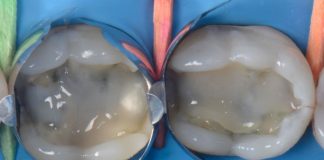
Recently, a great effort has been placed in saving as much tooth structure as possible. Truss access cavity have been introduced with he claim of increasing the fracture resistance. This study investigated the difference, in terms of fracture resistance, between a conservative access cavity and a truss access cavity.


Fig.1
60 lower molars were measured and divided into 6 groups.

Fig.2
Groups 1, 3 and 5 featured a conservative access cavity with, respectively, 4, 3 and 2 remaining walls.
Groups 2, 4 and 6 featured a conservative access cavity with, respectively, 4, 3 and 2 remaining walls.

Fig.3
After the endodontic treatment, direct restorations were performed according to the bulk and body technique from Style Italiano.

Fig.4
Teeth were then subjected to load until fracture.

Fig.5
And fracture patterns were measured to understand the type (restorable VS non restorable) of fracture.

Fig.6
An example of the measurements.

Fig.7
The results clearly show that there is no difference between truss and conservative. Considered the higher risk and difficulty of the truss access, it is advisable to prefer the conservative access. It is also notable that the resistance to fracture decreases strongly for groups 5 and 6, indicating that a cusp coverage is mandatory whenever the two residual walls are missing.
Bibliography
1- Influence of Access Cavity Preparation and Remaining Tooth Substance on Fracture Strength of Endodontically Treated Teeth. – Corsentino G, Pedullà E, Castelli L, Liguori M, Spicciarelli V, Martignoni M, Ferrari M, Grandini S. J Endod. 2018 Sep;44(9):1416-1421
2- Fracture Strength of Endodontically Treated Teeth with Different Access Cavity Designs. -Plotino G, Grande NM, Isufi A, Ioppolo P, Pedullà E, Bedini R, Gambarini G, Testarelli L. J Endod. 2017 Jun;43(6):995-1000