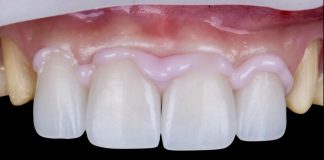
This is a typical scenario in restorative dentistry: old fillings wearing out because of secondary cavities. In this case, the tooth still responds well to vitality tests, so the plan is to clean out the cavity, and then use a digital process to create an adhesive restoration.

Fig.1
Pre-operative x-ray.

Fig.2
This picture shows the field isolation. If you’re able to use a rubber dam, you can think about using an adhesive restoration, like an overlay.

Fig.3
In this situation, ensuring proper isolation requires using an additional clamp to secure the dam in place and to make the margin visible.

Fig.4
Once the margin is cleaned and the buildup is completed, it’s time to take a digital impression using Prime Scan by Dentsply Sirona.

Fig.5
Before taking removing the dam and taking the impression, it’s crucial to take a lateral view to assess whether adjustments are needed to the interproximal walls of adjacent teeth. This ensures a perfect contact point with the overlay. It’s common to find that the preparation is well done, but irregular profiles on adjacent teeth make it impossible to create stable contact areas.

Fig.6
If you’re unable to take a picture for these considerations beforehand, you can assess it through the view after taking the impression with the scanner. This is another advantage of the intraoral scanner.

Fig.7
This is the technical design of the overlay where you can examine the shape.

Fig.8
Lateral view after cementation.

Fig.9
Occlusal view after cementation.

Fig.10
A post-cementation X-ray is necessary to verify whether the composite or cement has flown under the margin and gum line.

Fig.11
Occlusal view after bite check.
Conclusions
Today, daily restorative dentistry demands proficiency in both digital workflows and manual skills to handle rubber dam isolation in complex cases. Once isolation is achieved, adhesive protocols can promote long-term durability. With a clean field, it’s possible to manage cases with deep lesions without resorting to endodontic treatment. After bonding the overlay, it’s essential to confirm with an X-ray whether any cement residues remain.
Bibliography
- Veneziani M. Posterior indirect adhesive restorations: updated indications and the Morphology Driven Preparation Technique, Int J Esthet Dent 2017, 12(2):204-230.
- Magne P. Composite Resins and Bonded Porcelain: The Postamalgam Era. J Calif Dent Assoc 2006 34(2):135-147.
- Duarte S et al. Adhesive Resin Cements for Bonding Esthetic Restorations: a Review. QDT 2011, 34:40-60.
- Boeddinghaus M, Breloer ES, Rehmann P, Wöstmann B. Accuracy of singletooth restorations based on intraoral digital and conventional impressions in patients. Clin Oral Invest. 2015;19:2027–2034.
- D’Arcangelo C, Vanini L, Casinelli M, Frascaria M, De Angelis F, Vadini M, D’Amario M. Adhesive Cementation of Indirect Composite Inlays and Onlays: A Literature Review. Compend Contin Educ Dent. 2015;36(8):570-7.