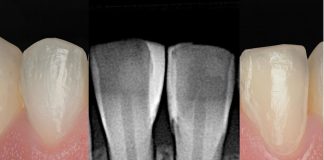
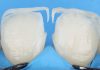
Designing a new smile in just one appointment is both a challenge and a privilege. It means observing shapes evolve in real time, planning how the soft tissues will adapt as we refine a parabola, tracing the transition lines and adjusting them to achieve the desired optical balance, and opening the embrasures between incisal edges to restore natural harmony.
This is the essence of dental artistry — precision guided by perception. Yet, the true reward lies in the patient’s eyes: the expression of someone who has long envisioned this change and now places complete trust in your expertise. To make this moment possible, our focus must remain on the shape, while allowing the materials to support us in adhesion and shade integration.
Only through this balance can we achieve a result that feels both natural and enduring.



Fig.1
Initial image of the restoration to be replaced, including the occlusal view that reveals the various tooth rotations. The inconsistencies in the curvature of the dental arches and the incisal margins are clearly visible.

Fig.2
We begin by adding composite to the tooth positioned palatally.
With Filtek Easy Match, three shades are available — Bright, Natural, and Warm. We always start the trial with the most neutral tone. If it appears too light, we switch to Warm. If Warm seems too yellowish, we switch to Bright.


Fig.3
In this case, Filtek Easy Match Warm proved to be the most suitable option.

Fig.4
Without anesthesia, we limit the preparation to the teeth requiring minimal adjustment. Tooth 21, positioned too far labially, required reduction in the bucco palatal direction. The same tooth also needed a higher parabola to achieve harmony with the adjacent teeth. In this step, the Gengiva LM retractor proves to be an indispensable aid.

Fig.5
We start the build-up on tooth 21 using Gengiva LM for cervical retraction and sandblasting with KaVo Rondoflex, employing 50-micron aluminum oxide powder.

Fig.6
With gingival retraction maintained, we etch only the enamel using Scotchbond Universal, eliminating the need for dentin etching and simplifying the procedure.
After 30 seconds, rinse thoroughly with a water spray and gently dry the cavity.

Fig.7
Apply the adhesive to the etched surface using a dedicated brush for precision.

Fig.8
Allow Scotchbond Universal Plus to sit for at least 20 seconds before light-curing, following the manufacturer’s instructions (minimum 20 seconds) with Elipar DeepCure.


Fig.9
Position the Unica matrix to control the final shape with a single composite application. Based on our try-in, Filtek Easy Match Warm was selected.

Fig.10
View of the matrix in position, followed by an immediate post-removal image.

Fig.11
Now, the focus shifts entirely to the shape. Color is no longer the concern — shape is the goal.

Fig.12
Before and after.
Conclusions
The same method was applied to the adjacent teeth within the same session — a single appointment that delivered a complete transformation.
Bibliography
- Poggio C., Lombardini M., Gaviati S., Chiesa M.
Evaluation of Vickers Hardness and Depth of Cure of Six Composite Resins Photopolymerized with Different Polymerization Modes.
Journal of Conservative Dentistry, 2012, 15(3), 237–241.
doi:10.4103/0972-0707.97945. - Homaei E., Farhangdoost K., Eskandarion S., Shadfar S.Effect of Thermocycling and Water Storage on Flexural Strength of Nanofilled and Bulk-Fill Resin-Based Composites. Journal of Dental Research, Dental Clinics, Dental Prospects, 2016, 10(4), 252–259. doi:10.15171/joddd.2016.039.
- Fornazari I.A., Wille I., Meda E.M., Brum R.T., Souza R.O. Optical and Surface Properties of Composite Resins After Accelerated Aging as a Function of the Immersion Medium. Journal of Esthetic and Restorative Dentistry, 2017, 29(5), 362–369. doi:10.1111/jerd.12311.
- Van Ende A., De Munck J., Van Landuyt K.L., Peumans M. Bulk-Fill Composites: A Review of the Current Literature. Journal of Adhesive Dentistry, 2017, 19(2), 95–109. doi:10.3290/j.jad.a38102.
- Alzraikat H., Taha N.A., Salameh Z. Bond Strength of Nano-Filled, Micro-Hybrid, and Silorane-Based Resin Composites to Dentin. Journal of Clinical and Experimental Dentistry, 2017, 9(3), e349–e355. doi:10.4317/jced.53523.