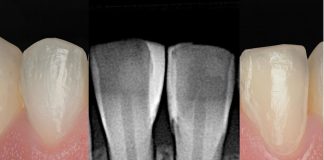
A clinical case by our Community member Dr. Prjeen Bazeed
This article and its content are published under the Author’s responsibility as an expression of the Author’s own ideas and practice. Styleitaliano denies any responsibility about the visual and written content of this work.
The anterior region requires a precise balance between biological stability, structural integrity, and visual harmony. When this balance is disrupted by compromised composite restorations, a comprehensive redesign is required to address both functional and aesthetic demands.
By reassessing the anterior segment as a unified aesthetic and functional system, compromised restorations can be reconstructed through controlled management of morphology, surface texture, and light interaction. Advances in adhesive dentistry and contemporary composite materials allow for accurate removal, structured rebuilding, and refined surface characterization.
This clinical case presents an anterior aesthetic redesign beyond existing composite restorations, focusing on biological correction and controlled reconstruction to achieve a cohesive and natural smile outcome.

Fig.1
Initial smile view showing compromised anterior composite restorations with visible discoloration and loss of aesthetic integration within the smile.

Fig.2
The retracted intraoral view showed compromised anterior composite restorations with fractured margins, discoloration, and loss of morphological continuity. An uneven gingival margin was evident, requiring minor gingival correction as part of the overall aesthetic rehabilitation.

Fig.3
The rubber dam isolation was featured by floss ligatures providing effective gingival retraction and a clean, controlled working field. This setup allowed clear visualization of the tooth surfaces and existing composite margins prior to the restorative procedures.

Fig.4
Existing composite restorations and carious tissue were removed, and the enamel surfaces were conditioned to prepare for the next restorative phase.

Fig.5
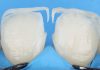
The palatal shell was built freehand using an enamel composite with the aid of a transparent strip to establish the initial palatal contour.

Fig.6
After construction of the palatal shell, a dentin composite was applied to restore internal anatomy and volume, followed by selective application of white, blue, and clear tints in the incisal area to create a natural translucent effect.

Fig.7
The final enamel layer was applied to complete the restoration, improving surface continuity and overall brightness. This layer helped unify the optical properties of the restoration, contributing to a balanced and natural final appearance.

Fig.8
After rubber dam removal, finishing and polishing were guided by morphological reference lines to refine tooth proportions, transitional line angles, embrasures, and incisal edge symmetry.

Fig.9
Final smile view after finishing and polishing, showing harmonious proportions, refined morphology, and a natural surface texture.

Fig.10
The intraoral retracted view after finishing and polishing shows the final restorations and the corrected gingival contour improving symmetry and integration.

Fig.11
Before and after smile view following direct composite restorations.
Conclusions
This clinical case illustrates how direct composite veneers can be used to manage anterior aesthetic challenges through a conservative and controlled approach. Careful attention to tooth morphology, surface texture, and optical characteristics, combined with precise finishing and polishing, allowed the restorations to blend naturally with the surrounding dentition.
Within the limitations of a single clinical report, the result highlights the versatility of direct composite restorations as a minimally invasive option for aesthetic enhancement when proper planning and execution are applied.
Bibliography
- Dietschi D.Optimizing tooth form, surface texture, and optical integration in anterior composite restorations.European Journal of Esthetic Dentistry. 2008;3(1):14–29.
- Fahl N Jr.Direct Composite Bonding in Anterior Dentistry: A Clinical Guide.Quintessence Publishing; 2015.
- Coachman C, Calamita M.Digital smile design: A tool for treatment planning and communication in esthetic dentistry.Quintessence of Dental Technology. 2012;35:103–111.
- Hardan L, Bourgi R, Kharouf N, Mancino D, Zarow M, Jakubowicz N, Haikel Y, Cuevas-Suárez CE.Bond strength of universal adhesives to dentin: A systematic review and meta-analysis.Polymers. 2021;13(5):814.