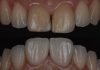
Clinical Case in collaboration with Dr. Daniele Rondoni (DT)
One of the most demanding esthetic challenges in dentistry arises when an anterior tooth presents with a compromised appearance that disrupts the harmony of the smile. Such defects, whether due to previous restorations, discoloration, or structural inconsistencies can significantly affect a patient’s self‑image and social confidence, especially in the highly visible anterior region.
Modern adhesive dentistry now offers sophisticated solutions for these situations. Among the most impactful is the ability to veneer a zirconia crown and natural teeth simultaneously, allowing clinicians to unify color, texture, and light dynamics across different substrates. This technique bridges the gap between prosthodontics and restorative dentistry, enabling seamless esthetic integration even when the underlying materials differ.
In this article, we present an anterior esthetic case managed through a combined approach: veneering a zirconia crown basement while harmonizing adjacent natural teeth with restorative techniques. This strategy demonstrates how thoughtful material selection, layering protocols, and adhesive procedures can transform a challenging esthetic scenario into a natural, pleasing smile. It highlights the transformative potential of contemporary restorative dentistry in addressing one of the most nuanced esthetic problems clinicians face today.

Fig.1
A patient presented to our clinic with an esthetic concern in the anterior region, particularly involving the upper right central incisor (tooth 11), which had been restored 20 years earlier.
Following comprehensive clinical and radiographic evaluation, the proposed treatment plan included replacing the existing crown on tooth 11 and placing veneers on teeth 21, 22, and 12.
The treatment options were discussed in detail with the patient, who consented to the plan.
The primary challenge in such cases lies in achieving a harmonious restoration of tooth 11 that seamlessly integrates with the shade and translucency of the future veneers on the adjacent teeth. To optimize the esthetic outcome, we adopted a “veneering zirconia approach,” involving the cementation of a zirconia base on tooth 11, followed by the placement of Lithium Disilicate veneers on all maxillary incisors.

Fig.2
A digital impression (Helios 500, Eighteeth, China) was taken, and the Digital smile design was performed.

Fig.3
The old crown on tooth number 21 was removed, preparation refined following the BOPT concept.

Fig.4
The Optishade colorimeter (Smile Line, Switzerland) was used to quantify the shade difference between teeth 11 and 21. These objective measurements provide the laboratory technician with a precise reference to fabricate a zirconia substructure for tooth 11 that closely replicates the optical properties of the adjacent central incisor.

Fig.5
A zirconia substructure was fabricated (3D Pro Zir, Aidite, China), maintaining the same reduction space as that prepared for the adjacent veneers.
Its shade was precisely selected based on the Optishade measurements to ensure seamless integration with the neighboring central incisor.


Fig.6
The zirconia substructure was evaluated intraorally using ENA Cem Try-In paste (Micerium, Italy).
Shade compatibility with the adjacent central incisor was assessed using the Optishade colorimeter, providing objective data to guide the selection of the final resin cement shade for bonding of the basement (ENA Cem, Micerium, Italy).

Fig.7
The Lithium Disilicate veneers (Aidite, Qinhuangdao, China) were milled and tried in the mouth.

Fig.8
A view of the final outcome following milling, staining, and bonding reveals a seamless integration across the four veneers. This harmonious result was made possible by fabricating a zirconia substructure precisely matched to the shade of the adjacent teeth, ensuring natural continuity and esthetic coherence.

Fig.9
A lateral view of the final result.

Fig.10
A three years follow‑up demonstrates excellent treatment stability and healthy gingival healing, underscoring the strength of the treatment plan and the thoughtful selection of materials used throughout the case.
Conclusions
This case highlights the power of meticulous diagnosis, digital precision, and material-driven strategy in achieving long‑term esthetic success. By combining objective shade analysis with a customized zirconia substructure and carefully harmonized veneers, we were able to recreate natural optical behavior across the anterior segment. The three years follow‑up confirms not only the stability of the restorations but also the healthy integration of the soft tissues, reflecting both biological respect and technical accuracy. Altogether, this workflow demonstrates how thoughtful planning, interdisciplinary coordination, and advanced materials can restore not just a tooth, but the patient’s confidence in their smile.
Bibliography
- Loi, E. (2013). Biologically oriented preparation technique (BOPT): a new approach for prosthetic restoration of periodontically healthy teeth. Eur J Esthet Dent, 8(1), 10-23.
- Walter Devoto. Successful replacement of a single anterior central incisor with zirconia, guided by OptiShade colorimeter. www.Styleitaliano.org
- Walter Devoto. When veneering, an implant and a natural tooth, solves an esthetic problem. www.styleitaliano.org