A clinical case by our Community member Dr. Ayman Mohamed
This article and its content are published under the Author’s responsibility as an expression of the Author’s own ideas and practice. Styleitaliano denies any responsibility about the visual and written content of this work.
Direct anterior composite restorations represent a minimally invasive and highly aesthetic treatment option when proper stratification optical integration, and surface texture reproduction are respected. The replacement of unaesthetic restorations in the aesthetic zone requires careful diagnosis, shade analysis and a biomimetic layering approach to mimic natural enamel and dentin behavior.
This case report presents the aesthetic replacement of an unaesthetic composite restoration in a 26-year-old female patient using a conservative direct technique.

Fig.1
Initial smile analysis revealing disharmony in value and translucency of the maxillary right central incisors affecting the overall anterior aesthetic balance.

Fig.2
Pre-operative close-up revealing value discrepancy, loss of natural translucency and surface texture deficiency in the maxillary central incisor restoration.

Fig.3
Pre-operative close-up highlighting the natural incisal opalescence and halo effect, on the left upper central, which were carefully analyzed to guide the natural layering strategy and reproduce the optical characteristics of the adjacent central.

Fig.4
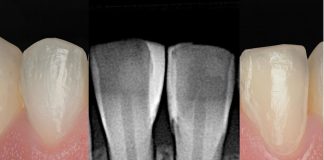
Polarized image used for precise dentin and enamel shade analysis.
Cross-polarization eliminates surface reflections allowing accurate evaluation of value distribution, chroma intensity and internal optical characteristics of the natural tooth structure.

Fig.5
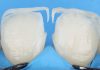
Split-dam isolation was applied to ensure optimal moisture control. Selective removal of the pre-existing composite was performed under magnification followed by air-abrasion with 27 µm aluminum oxide particles to enhance surface cleanliness and micromechanical retention while preserving sound enamel.

Fig.6
A silicone index derived from the diagnostic mock-up was used to build the palatal shell establishing the correct incisal edge position and length using an enamel shade A2 (Harmonize, Kerr, California, USA).

Fig.7
After building the palatal shell using Enamel A2 (Harmonize, Kerr, California, USA), the morphology was carefully evaluated. At this stage, any necessary corrections in contour and incisal edge position can be performed using a #12 blade or finishing discs before proceeding to the next stratification step.

Fig.8
The dentin core was built using Dentin A2 (Harmonize, Kerr, California, USA) to reproduce internal chroma and mamelon morphology. Controlled reduction of the incisal third was maintained to preserve space for optical effects, including opalescence, halo effect and the final enamel layer.

Fig.9
The incisal optical effects were reproduced by applying an opalescent composite in the incisal third and a dentin shade to mimic the natural halo effect. This step is crucial for evaluating depth, light diffusion and integration with the adjacent natural teeth.

Fig.10
Immediate result after stratified composite restoration recorded before tooth rehydration, final polishing and surface texture characterization which were completed during the follow-up session.

Fig.11
Final clinical result after rehydration, multi-step polishing and surface texture characterization. The restoration exhibit optimal gloss, biomimetic surface anatomy and seamless optical integration with the surrounding natural teeth.

Fig.12
Final smile view showing proper value integration, harmonious proportions and natural optical blending of the restorations within the overall facial context.

Fig.13
Final macro view showing correct value, opalescent effect and natural surface texture following finishing, polishing and rehydration.
Conclusions
Accurate shade analysis and controlled layering with enamel and dentin shades enabled proper value reproduction and natural optical integration. The palatal shell provided a stable anatomical reference, while dentin layering was performed with intentional space to reproduce incisal opalescence and halo effects, contributing to a lifelike optical outcome.
Final enamel layering, surface texture characterization, and multi-step polishing enhanced gloss, translucency, and surface morphology. The follow-up after rehydration confirmed correct value recovery and harmonious blending of the restorations with the adjacent dentition and overall smile.
Within the limits of this clinical case, a minimally invasive stratification approach, combined with precise control of value, translucency, and surface texture, can achieve predictable, natural, and highly aesthetic results in anterior direct composite restorations. Direct composite restorations remain a reliable and minimally invasive solution for aesthetic rehabilitation in the anterior region, allowing optimal optical integration and long-term stability.
Bibliography
- Manauta J, Salat A, Putignano A, Devoto W, Paolone G, Hardan LS. Stratification in anterior teeth using one dentine shade and a predefined thickness of enamel: A new concept in composite layering. Odonto-Stomatol Trop. 2014;37(147):5‑16.
- Manauta J, Salat A, Devoto W, Paolone G. Direct Composite Restorations – Layers 2: The Styleitaliano Clinical Secrets. Berlin: Quintessenz Verlags-GmbH; 2016.
- Vanini L. Conservative Restoration of Anterior Teeth. Milan: ACME; 2007.
- Magne P, Belser UC. Biomimetic Restorative Dentistry. 2nd ed. Berlin: Quintessenz Verlags-GmbH; 2022.