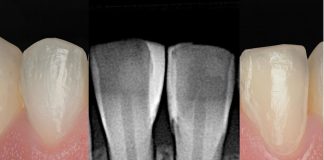
It’s always rewarding to offer patients something both beautiful and functional. As materials evolve and technologies improve, cases like this make it feel as though we’ve turned back the clock—restoring the tooth to its pre-treatment state. By combining Essential Lines with modern materials that simplify clinical procedures, we can focus on what truly matters—for both the patient and ourselves: a stable, long-lasting, and aesthetically pleasing result, achievable within a short time frame.


Fig.1
The tooth was isolated with the rubber dam. We began conservatively removing the amalgam restoration, aiming to preserve as much healthy enamel as possible.

Fig.2
Once the cavity was cleaned, we proceeded with etching. Only the enamel was etched, as we were using a universal adhesive that did not require dentin etching. This simplifies the procedure and reduces the risk of post-operative sensitivity. After 30 seconds, the etchant was rinsed off with water spray, and the cavity was gently dried.

Fig.3
The adhesive was applied into the etched cavity using a dedicated microbrush.

Fig.4
Scotchbond Universal adhesive was allowed to sit for at least 20 seconds.


Fig.5
Using LM Solo Posterior, we measured the depth of the cavity to decide how many composite layers would be necessary.

Fig.6
Light-curing was performed according to the manufacturer’s instructions, for a minimum of 20 seconds. With high-performance lights like the Elipar DeepCure, we were able to ensure thorough polymerization.

Fig.7
Over-curing is never a problem—there is no such thing as an “over-polymerized” composite.

Fig.8
Applying a flowable composite as a cavity liner is always a good idea, especially when using a material with optimal viscosity, such as Filtek Bulk Fill Flowable by Solventum.

Fig.9
A special tip designed for Filtek Bulk Fill Flowable ensures bubble-free application—particularly effective when the tip remains immersed in the material during extrusion.


Fig.10
Left image: the flowable layer was applied in the cavity.
Right image: we began layering the paste composite.

Fig.11
For this restoration, we had chosen Filtek Easy Match. Thanks to its opacity, it offered excellent aesthetics and handling. It could be used as a single-layer material, as the cavity depth (combined with the flowable base) was less than 2 mm.


Fig.12
We started shaping using Essential Lines, beginning at the center and then outlining the buccal groove.

Fig.13
Next, we defined the mesial and distal grooves, softening the anatomy with a dry brush.

Fig.14
If the grooves appear too deep, we can easily soften or close them.

Fig.15
Final check immediately after placement and at the two-week follow-up.
Conclusions
By combining modern materials with simplified clinical protocols, we were able to restore the tooth in a conservative, efficient, and highly aesthetic manner.
Bibliography
- Hardan L, Sidawi L, Akhundov M, Bourgi R, Ghaleb M, Dabbagh S, Sokolowski K, Cuevas-Suárez CE, Lukomska-Szymanska M. One-year clinical performance of the fast-Modelling bulk technique and composite-up layering technique in class I cavities. Polymers. 2021 Jun 4;13(11):1873.
- Attar N. Influence of flowable composite lining on the microleakage and adaptation of composite restorations. Journal of Dentistry. 2016 Mar;44:14-20.
- Ilie N, Hickel R. Resin composite restorative materials in the light of durability and clinical performance investigations. Dent Mater. 2011 Jan;27(1):29-43.
- Chiodera G, Orsini G, Tosco V, Monterubbianesi R, Manauta J, Devoto W, Putignano A. Essential Lines: a simplified filling and modeling technique for direct posterior composite restorations. Int J Esthet Dent. 2021 May 10;16(2):168-184.