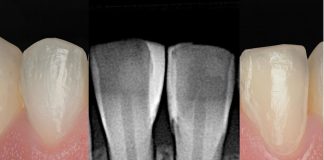
It is a material made for integral core build-up: it is therefore possible to use it for both the intracanal and coronal section. The material polymerizes in both, auto and photo mode.
Adhesive is always required for it to adhere to the polish, the dentin as well as to the post.

Fig.1
It features 3 main characteristics:
No bubbles: because of its self-mixing tip, the chance of obtaining bubbles is nearly none, provided it is distributed correctly.
Handling: It is very comfortable to maneuver, and it is easily adaptable to every reconstructive scenario, having the possibility of choosing between two different textures. The result, once the reconstruction is done, is a rather hard material, as a normal type of composite would be, opposed to other materials where the burr sinks.
Fast: By rebuilding with the same material as the canal section at the top of the abutment, we manage to effectively reduce the risk of creating bubbles and the interface to the minimum, and we effectively reduce the execution time.

Fig.2
There are two types:
FLOW: more fluid, bigger, good sliding capacity, effectively manages to be inserted in cavities and narrow spaces.
STACKABLE: this specific texture allows you to build the abutment vertically, as, by being highly dense, the material tends to maintain its shape and allows you to “climb up” with the reconstruction until reaching the desired height.

Fig.3
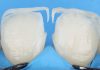
To the left, a traditional dual material. To the right, PREDICTA core STACKABLE.

Fig.4
One can easily notice how the transitional corners with the flat part differ from each other: the traditional one on the left tends to wet the surface, whilst to the right PREDICTA STACKABLE tends to stay still thereby not wetting the surface.

Fig.5
A further characteristic that is not easily noticeable from the outside, but that we can experiment with while milling the abutment, is the near absence of bubbles inside the material.

Fig.6
Injecting the material while keeping the tip inside the material we just extruded, significantly reduces the chances of creating bubbles inside the material.

Fig.7
With this material we can rebuild the entire abutment: it’s not an auto-adhesive material, it always require a bonding agent compatible with dual core composite for both, the intra-radicular component and the coronal one. Similarly, it require adhesive in order for it to adhere to the post correctly.

Fig.8
With Predicta Core we are able to:
Rebuild just the coronal area,
Cement the post,
Rebuild the entire abutment, from the post’s cementation to the coronal portion.

Fig.9
As a first step, we will choose the post.

Fig.10
We will then employ an adhesive on the entire surface that we will be able to rebuild. It is important to remember that where the light will not reach, we will need to employ an auto-polymerizing adhesive.

Fig.11
For what concerns the adhesive on the abutment, it is advisable to bring it to the correct height before starting the adhesive phases in a way that would not get in the way of the lamp for photo-polymerization.

Fig.12
The post, when being the right length, it does not get in the way of our attempts of injecting or adapting the rebuilding material. Either when rebuilding the entire abutment in one seating (both the radicular and coronal component)

Fig.13
Or when we divide the operation in two steps: first the intracanal part.

Fig.14
Then the coronal part.

Fig.15
Integral reconstruction of two abutments, with Predicta Core
Try the post. If they have stops in silicone, those will help determining the correct length and cutting them correctly.

Fig.16
Isolation with dam, liquid dam on 47 and flowable wings on 45. Adhesive distributed in the cavity.

Fig.17
Predicta Core stackable with its dedicated self-mixing tip.

Fig.18
First on the 47, inserting the tip at the deepest end possible.

Fig.19
Then on the 45, once again inserting the tip at the deepest end possible.

Fig.20
Initially, we place the material on solely on the canals.

Fig.21
We then position the posts that have been previously treated with adhesive.

Fig.22
Occlusal vision.

Fig.23

Fig.24
We then add Predicta Core in one addition in the coronal portion.

Fig.25
We then obtain two reconstructions ready for the prosthetic preparation.

Fig.26
Conclusions
Predicta Core, with its two densities, its simplicity of use, and its variety of clinical applications, allows us to solve many situations with just a single material, making our job easier.