


A clinical case by our Community member Dr. Luis Alberto Nuñez Mata
This article and its content are published under the Author’s responsibility as an expression of the Author’s own ideas and practice. Styleitaliano denies any responsibility about the visual and written content of this work.
Closing an anterior diastema involves more than filling a space. The challenge lies in balancing tooth proportions, shaping natural emergence profiles, and establishing proximal contacts that integrate with the surrounding tissues. Direct composite restorations offer a conservative approach to these objectives, allowing changes in tooth form while preserving dental structure.
The Front Wing Technique, developed by Jordi Manauta, approaches this process by establishing the buccal contours first. These initial composite wings provide a reference for the subsequent placement of anatomical sectional matrices and completion of the proximal and palatal surfaces. Separating these stages allows the clinician to focus on the visible shape before refining the contact area and cervical adaptation. Although this workflow can be completed without a palatal silicone index, careful assessment and restorative planning remain essential.
This case report illustrates single-visit closure of a midline diastema using the Front Wing Technique and a single-shade composite approach.

Fig.1
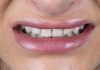
A 35-year-old female patient presented to our clinic seeking to improve the aesthetic appearance of her smile, as she was dissatisfied with the presence of a diastema. The treatment plan focused on closing the space with direct composite resin using the Front Wing Technique, with the aim of achieving a natural result while preserving tooth structure.

Fig.2
Rubber dam isolation was performed to control moisture and improve visibility of the operative field, facilitating the subsequent adhesive and restorative procedures.

Fig.3
B4 clamps were placed on teeth 11 and 21 to achieve additional gingival and rubber dam retraction. Exposure of the cervical area is essential for controlling the new emergence profiles and preventing restorative overhangs.

Fig.4
The enamel surfaces were extensively etched. Because the definitive restorative margins are established during freehand modeling, the etched area was extended beyond the anticipated limits of the composite.

Fig.5
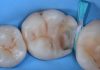
Application of the adhesive with a Compo Brush (Smile Line, St-Imier, Switzerland) over the entire previously etched surface.

Fig.6
Illustration of buccal wall reconstruction for diastema closure using the Front Wing technique.

Fig.7
The front wing anatomy was sculpted using the Solo Anterior (LM Arte- Style Italiano) instrument.

Fig.8
Refined with CompoBrush (SmileLine, St-Imier, Switzerland).

Fig.9
The first buccal wing was sculpted freehand using Brilliant EverGlow (Coltene/Whaledent, Langenau, Germany), shade A2/B2, establishing balanced proportions and a natural emergence profile before light-curing. The process was repeated on the adjacent tooth, leaving a small gap between the wings for subsequent matrix placement and completion of the palatal surfaces.

Fig.10
Illustration of uncured flowable composite positioned in the proximal space before placement of the overlying composite using the snowplow technique.

Fig.11
Sectional matrix (QuickmatFLEX, Polydentia, Mezzovico-Vira, Switzerland) in position before placing flowable composite behind the buccal wing, in preparation for the snowplow technique.

Fig.12
Packable composite was compacted over the uncured flowable layer, causing excess flowable resin to emerge buccally and promoting adaptation between the materials. The excess was removed before light-curing both composites together.

Fig.13
Clinical view showing the flowable composite emerging onto the buccal surface.

Fig.14
The purpose of this step is not to modify the contact point, but to carefully eliminate cervical excess. This is accomplished using a metal finishing strip by passing its non-abrasive section through the contact area while directing the abrasive surface exclusively toward the cervical region.

Fig.15
Initial finishing with an abrasive disc was used to correct the facial outline, incisal contour, and transitional line angles of both restorations.

Fig.16
A pre-polishing rubber wheel Diatech (Coltene/Whaledent, Langenau, Germany) was used to smooth the composite surface and eliminate irregularities created during the initial finishing procedure.

Fig.17
A finer rubber polisher Diatech (Coltene/Whaledent, Langenau, Germany) was then used to smooth the surface and improve its luster before high-gloss polishing.

Fig.18
High-gloss polishing was initiated with the Lucida polishing paste (DiaShine, USA).

Fig.19
Final polishing was completed with a Lucida Star (DiaShine, USA) to obtain a smooth, glossy surface that facilitates optical integration and plaque control.

Fig.20
Lateral view at the one-month follow-up, demonstrating the facial convexity, incisal integration, and continuity of the restorative emergence profiles with the surrounding tissues.

Fig.21
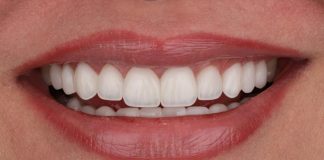
Final smile at the one-month follow-up. The direct restorations provided harmonious closure of the midline diastema while preserving tooth structure and maintaining a natural relationship with the adjacent dentition.
Conclusions
This case shows how a straightforward clinical sequence can address an aesthetic challenge that requires attention to detail. The Front Wing Technique allowed the buccal shape to be defined first and the outcome to be previewed before completing the proximal reconstruction with sectional matrices. This approach allows the clinician to focus on one objective at a time: establishing proportions and contour, then addressing proximal contact and cervical adaptation.
The possibility of working without a palatal silicone index, adjusting the shape directly, and completing treatment in a single visit in selected cases makes this a technique worth learning and incorporating into clinical practice. Its value lies in providing an organized sequence for diastema closure while preserving tooth structure. Planning, isolation, and careful finishing and polishing remain essential to achieving a natural result.
Bibliography
- Manauta J, Salat A. Layers 2. Direct Composites: The StyleItaliano Clinical Secrets. Quintessence.
- The Front Wing Technique – Jordi Manauta – 2017
- Dietschi D. Optimizing smile composition and aesthetics with resin composites and other conservative aesthetic procedures. Eur J Esthet Dent 2008; 3(1):14-29.
- Jordi Manauta, Anna Salat, Riccardo Monterubbianesi, Vincenzo Tosco, Walter Devoto, Giovanna Orsini, Angelo Putignano. Advances in diastema closure and tooth shape change using direct composite restorations: the Front Wing Technique. 2022 Nov. PMID: 36426611.
- Single shade everyday – Jordi Manauta – 2020