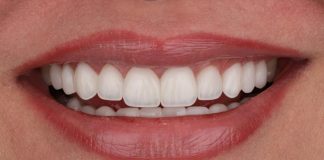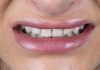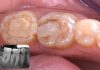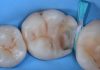


Restoring a smile in the presence of a single anterior crown can be particularly challenging when a minimally invasive approach is desired. Achieving a harmonious result requires not only correcting tooth shape and symmetry, but also ensuring that the prosthetic restoration integrates naturally with the surrounding teeth in terms of color and optical behavior. In this case, the patient presented with worn and irregular incisal edges, smile asymmetries, and an existing PFM crown on the endodontically treated tooth 22. Since the remaining teeth were healthy, the treatment plan aimed to preserve as much natural tooth structure as possible while improving esthetics, occlusion, and anterior guidance.


Fig.1
Tooth 22 had previously undergone endodontic treatment and was restored with a PFM crown. Signs of wear and cracks were also visible along the incisal edges, suggesting issues related to guidance or occlusion. Overall, the teeth were healthy, and the patient requested a minimally invasive solution.

Fig.2
Treatment planning began with a digital wax-up to evaluate the final tooth shapes and occlusion. The plan was to increase posterior support and reduce the load on the anterior teeth associated with the existing wear pattern.

Fig.3
The digital wax-up made it possible to preview the amount of length and volume to be added to the existing teeth. From this perspective, the planned changes were entirely additive, with no need to prepare the natural teeth.

Fig.4
During the first stage of treatment, the existing PFM crown was removed. A metal post was found underneath, and its removal was considered to pose an unnecessary risk to the remaining tooth structure.

Fig.5
The decision was therefore made to retain the existing post. The abutment and metal post were sandblasted to prepare the surfaces for the subsequent adhesive procedure.

Fig.6
The metal was covered using Scotchbond™ Universal Plus and Filtek™ XW to mask its visibility. Scotchbond™ Universal Plus contains MDP and silane, allowing adhesion to the metal surface.


Fig.7
After correction of the preparation and completion of the digital scans, a hybrid ceramic crown with a labial cut-back was designed and fabricated.

Fig.8
The thickness of the labial cut-back was designed to correspond to the additive volume planned for the surrounding teeth, creating space for the same veneering material.

Fig.9
At the following appointment, treatment continued with cementation of the new crown. The soft tissues had also healed following a minor gingivectomy performed to improve the symmetry of the anterior gingival margins.

Fig.10
Scotchbond™ Universal Plus and RelyX™ Veneer cement were used for the adhesive cementation of the hybrid ceramic crown.


Fig.11
An index was used to perform direct composite bonding on the natural teeth, improving shape, symmetry, and color. The posterior teeth were also restored occlusally to improve the bite. Because the hybrid ceramic material is primarily composite-based, direct bonding with Filtek™ XW could be continued over the cemented crown. The silane contained in Scotchbond™ Universal Plus enabled bonding of the composite to the hybrid ceramic surface, allowing the crown to be treated as part of the restorative sequence.

Fig.12
The composite restorations were shaped and finished using Sof-Lex™ discs according to the shaping and finishing protocol.


Fig.13
After shaping and finishing, all anterior teeth presented the same labial restorative material—Filtek™ XW. The crown itself was also directly veneered with composite, helping to create a uniform restorative surface.

Fig.14
Using the same material on the labial surfaces provides similar fluorescence and appearance under different lighting conditions. The patient was satisfied with the result, as the crown and direct restorations were no longer visually distinguishable within the smile.

Fig.15
Final smile. The lower teeth were also restored with composite bonding to complement the shade change and improve dental guidance.

Fig.16
The before-and-after comparison demonstrates the improvement in symmetry and tooth shape. The gingival margins are also more symmetrical, particularly around the crown. Occlusion and guidance were improved with the aim of reducing further wear.

Fig.17
Conclusions
Before-and-after comparison of the patient’s smile. This technique combines a hybrid ceramic crown with contemporary adhesive and composite materials to enable a conservative approach to anterior smile rehabilitation. Scotchbond™ Universal Plus, with its silane-containing formulation, allowed the restorative sequence to integrate the hybrid ceramic crown with direct composite veneering.
Using the same composite material on the labial surfaces of the anterior teeth and crown helped create a more even and harmonious appearance across the smile. In the past, the presence of a single crown in the anterior region might have led to preparation of adjacent teeth for ceramic restorations to achieve greater visual uniformity. With contemporary materials and adhesive techniques, a more conservative approach can be considered when improving the patient’s smile.
Bibliography
- de Abreu JLB, Sampaio CS, Benalcázar Jalkh EB, Hirata R. Analysis of the color matching of universal resin composites in anterior restorations. J Esthet Restor Dent. 2021;33(2):269–276. doi:10.1111/jerd.12659.
- Dixon DL. Overview of articulation materials and methods for the prosthodontic patient. J Prosthet Dent. 2000;83(2):235–247. doi:10.1016/S0022-3913(00)80017-7.
- Baldissera RA, Corrêa MB, Schuch HS, Collares K, Nascimento GG, Jardim PS, Moraes RR, Opdam NJM, Demarco FF. Are there universal restorative composites for anterior and posterior teeth? J Dent. 2013;41(11):1027–1035. doi:10.1016/j.jdent.2013.08.016.
- Okeson JP. Management of Temporomandibular Disorders and Occlusion. 6th ed. St Louis: Mosby; 2008:245–247.
- Goldstein MB. Universal composite resins: the “do-all” workhorses of dentistry…a system survey. Dent Today. 2005;24(2):160, 162, 164 passim.
- Ghazal M, Albashaireh ZS, Kern M. Wear resistance of nanofilled composite resin and feldspathic ceramic artificial teeth. J Prosthet Dent. 2008;100(6):441–448. doi:10.1016/S0022-3913(08)60262-0.
- Monteiro P. Essential Shape. The key to a tooth-like restoration. StyleItaliano. 2020.
- Vanini L, D’Arcangelo C. Estetica, funzione, postura. Viterbo: ACME; 2018.