


Achieving seamless esthetic integration between an implant-supported crown and adjacent natural teeth can be challenging, particularly in the anterior region. Differences in restorative materials, optical properties and underlying substrates may become noticeable within the smile.
This clinical case presents a minimally invasive approach combining an implant-supported hybrid ceramic crown with additive composite bonding to improve tooth shape, shade and overall smile harmony.


Fig.1
The patient presented with the desire to improve her smile. She had previously undergone orthodontic treatment for congenitally missing lateral incisors, during which the canine on one side was moved into the position of tooth 22 and reshaped, while space was created for an implant in position 12 on the opposite side. Her main concern was the appearance of the implant crown, particularly its color and visibility within the smile. She also wished to improve the shape and shade of the remaining teeth.

Fig.2
As the teeth were generally sound, we opted for a minimally invasive approach. As a first step, the existing implant crown was removed because its appearance was unsatisfactory, particularly due to the visibility of the metal abutment.

Fig.3
Both the new implant crown and the wax-up for the patient’s new smile were digitally designed.

Fig.4
To maximize the esthetic outcome while minimizing invasiveness, an individual abutment and a hybrid ceramic crown with a labial cut-back were designed. The thickness of the cut-back corresponded to the thickness of the planned wax-up.

Fig.5
This design allowed the crown to be veneered with composite after cementation, together with the rest of the smile.

Fig.6
To avoid the metal showing through, an individual zirconia hybrid abutment was fabricated. The abutment was designed as a definitive solution so that, even if the crown requires replacement in the future, the same abutment can be maintained.

Fig.7
The hybrid ceramic crown was then adhesively cemented to the abutment using Scotchbond™ Universal Plus Adhesive and RelyX™ Veneer Cement.


Fig.8
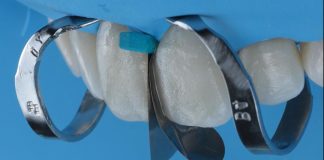
After cementation, all teeth were sandblasted and etched. Unica matrices (Polydentia) were used during additive composite bonding with Filtek™ Universal Restorative, shade B1. The patient requested a natural result, and treatment at this stage was limited to the upper arch. Bleaching of the lower teeth was planned subsequently.


Fig.9
Using Scotchbond™ Universal Plus Adhesive, which contains a silane component, composite bonding could be performed both on the unprepared natural teeth and over the hybrid ceramic crown. The composite restorations were shaped and finished using Sof-Lex™ discs according to the shaping and finishing protocol.


Fig.10
Clinical appearance after shaping and finishing.

Fig.11
Immediate postoperative appearance showing improved tooth shape and symmetry and closure of the anterior spaces. Gingival irritation was present following placement of the implant abutment and removal of the previous composite restoration from tooth 23, which had been moved into the position of the missing tooth 22.

Fig.12
At the one-month follow-up, all teeth—including the crown in position 12—were veneered with the same composite material, providing consistent shade and optical behavior. Healthy periodontal tissues and satisfactory healing around the restorations can also be observed, together with a good shade match between Filtek™ Universal B1 and the patient’s bleached lower teeth.

Fig.13
Final smile showing a natural shade and improved tooth shape.

Fig.14
The before-and-after comparison shows the esthetic improvement achieved with a minimally invasive approach. The natural teeth were not prepared, and although tooth 12 is an implant-supported crown, veneering it with the same composite used on the adjacent teeth helped achieve a harmonious integration.

Fig.15
Conclusions
Matching an implant-supported crown with adjacent composite restorations can be challenging, particularly when the patient has high esthetic expectations. Differences in fluorescence and light reflection between restorative materials can make optical integration between crowns and natural teeth difficult. In this case, the combination of a hybrid ceramic crown, Scotchbond™ Universal Plus Adhesive and additive composite veneering allowed the prosthetic restoration and the adjacent natural teeth to be veneered with the same restorative material, helping to achieve a more uniform optical appearance while maintaining a minimally invasive approach.


Bibliography
- de Abreu JLB, Sampaio CS, Benalcázar Jalkh EB, Hirata R. Analysis of the color matching of universal resin composites in anterior restorations. J Esthet Restor Dent. 2021;33(2):269–276.
- Baldissera RA, Corrêa MB, Schuch HS, Collares K, Nascimento GG, Jardim PS, Moraes RR, Opdam NJM, Demarco FF. Are there universal restorative composites for anterior and posterior teeth? J Dent. 2013;41(11):1027–1035.
- Goldstein MB. Universal composite resins: the “do-all” workhorses of dentistry…a system survey. Dent Today. 2005;24(2):160, 162, 164 passim.
- Monteiro P. Essential Shape. The key to a tooth-like restoration. StyleItaliano. Published June 10, 2020.