A clinical case by our Community member Dr. Hung Bui
This article and its content are published under the Author’s responsibility as an expression of the Author’s own ideas and practice. Styleitaliano denies any responsibility about the visual and written content of this work.
Nowadays, composite is one of the materials able to provide very highly esthetic results. Along with its high flexural strength, composite is widely applied to a wide variety of cases, including direct and indirect restorations.
In this case, I decided to choose composite as the material to be used, because of its aesthetics, durability, and affordable cost.

Fig.1
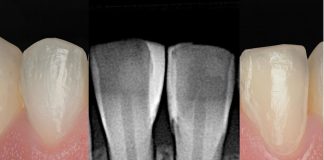
Initial situation: discoloration of tooth 12, old direct restorations at teeth 11, 21, 22. The patient wanted improve the appearance of her smile, while not having sufficient financial resources for ceramic restorations, so composite was chosen as a material for this case.

Fig.2
After removing old restorations, teeth 12, 21, 22 were treated endodontically and restored with post and core.

Fig.3
X-rays after endodontics and post and core treatment.

Fig.4
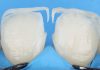
Wax-up on stone model. Although restarting the canines would have been advisable for aesthetic purposes, they weren’t included in the treatment because of financial reasons.

Fig.5
Wax-up, lateral view.

Fig.6
Provisional restorations were made using Luxatemp A1.

Fig.7
Indirect restorations are made by Harmonize composite, A2 shade (Kerr Dental).

Fig.8
The prepared teeth were isolated by placing the rubber dam.

Fig.9
Sandblasting by AquaCare to clean and get higher bond strength.

Fig.10
Cementation by Variolink Esthetic Neutral resin cement (Ivoclar Vivadent). Excess cement was removed and finish lines were cleaned and polished.

Fig.11
Immediate result after cementation.

Fig.12
X-rays were taken after cementation to check continuity and close fitting of the indirect composite restorations.

Fig.13
Before and after.

Fig.14
At 3-month follow-up.

Fig.15
The new smile after 3 months.
Conclusions
Indirect composite restorations are an easy and quick solution for highly esthetic results. For simple cases, indirect composite restorations is more economical than ceramic, and easier to perform than direct restoration.This method is suitable for practitioners who are young or need more training for full direct and indirect, ceramic-based treatments.
Bibliography
1. Gargari M, Ceruso FM, Pujia A, Prete V. Restoration of anterior teeth using an indirect composite technique. Case report. 2013 Apr; 6(4): 99–102.
2. Rappelli G, Coccia E, Putignano A. Restoration of anterior teeth with indirect composite partial coverage crowns: A clinical report. December 2004. The Journal of Prosthetic Dentistry Volume 92, Issue 6.
3. Monteiro P. Direct and indirect composites: the step by step video. 2017. www.styleitaliano.org.