Bonding is a great solution for aesthetic enhancements that require minimal invasion of healthy dentition. It is often chosen by patients who wish to change the shape or color of their smile without damaging their teeth. However, there are clinical situations where the use of composite materials can be problematic. One such situation is presented in the following clinical case.

Fig.1
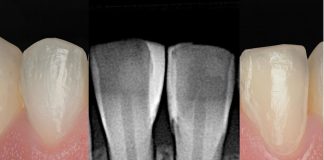
This patient came to our clinic seeking to enhance her smile with bonding. However, she already had a porcelain-fused-to-metal (PFM) crown on a single central incisor. Mixing ceramic and composite materials in the aesthetic zone can be challenging, as differences in color, light reflection, and fluorescence between the materials may result in noticeable discrepancies under various lighting conditions. Ideally, the same material—either ceramic or composite—should be used for all visible teeth. This case demonstrates how to successfully create a harmonious new smile using composite alongside an existing ceramic crown.

Fig.2
As a first step, the old crown was removed and the tooth preparation was refined.

Fig.3
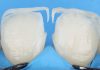
A 3D-milled crown made from a hybrid ceramic material (Aidite, China) with cutback was fabricated and cemented. This material was chosen because it allows for reliable adhesive bonding with composite.


Fig.4
After transferring the information from the wax-up, the remaining build-up was completed using matrices (Unica Anterior, Polydentia) to ensure well-condensed and smooth interproximal and gingival margins. A single shade of composite was used throughout.

Fig.5
Even though a single, very bright composite shade was used, the final result achieved a natural, life-like appearance thanks to careful polishing and surface texturing.

Fig.6
Thanks to the use of the same material on the labial surfaces, we were able to achieve uniform color and light reflection across all teeth—even though one of them is a prosthetic crown.
Conclusions
In cases like this, achieving a uniform shade and appearance across all teeth is possible—but only when the same material is used on all visible surfaces. This approach ensures consistent color and light reflection under any lighting conditions.
Using composite allowed us to deliver the smile our patient desired, while preserving her natural teeth by avoiding the more invasive preparations required for a full ceramic solution.
The complete workflow of this case will be featured in the Styleitaliano Year Book 2025.
Bibliography
- Manauta J, Salat A. Layers, An Atlas of Composite Resin Stratification. Quintessence Publishing Co; 2012.
- Monteiro P. Essential shape. The key to a tooth-like restoration. Styleitaliano.org, June 2020.
- Okeson JP. Tooth Wear Management of Temporomandibular Disorders and Occlusion. 2008, 6th edition. St Louis: Mosby; 2008. 245–247.