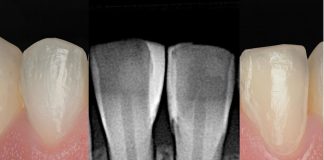
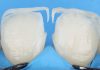
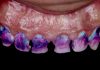
A clinical case by our Community member Dr. Volodymyr Oleksiuk
This article and its content are published under the Author’s responsibility as an expression of the Author’s own ideas and practice. Styleitaliano denies any responsibility about the visual and written content of this work.
Advancements in aesthetic dentistry are inspiring more and more people to enhance their smiles. Non-invasive, no-prep techniques make the process easy and comfortable for patients. In this clinical case, we closed diastemata using CAD/CAM restorations without altering the natural tooth structure.

Fig.1
The patient visited our clinic seeking to close the gaps between their teeth. A clinical examination revealed healthy teeth and gums, making a no-prep treatment possible. By using hybrid ceramics, we were able to create ultra-thin restorations that offer a natural appearance with minimal intervention to the tooth structure.

Fig.2
The design was created using Exocad software, maintaining the minimum allowable thickness. Two separate veneers were digitally modeled—one for each central incisor.

Fig.3
During milling, the restorations showed slight chipping compared to the virtual design. However, this is not a concern, as they taper seamlessly to a feathered edge. Their impressively thin profile highlights the precision of both the material and the technique.

Fig.4
We always adhere to the principle: “Measure seven times, cut once.” This careful approach ensures accuracy and minimizes the risk of errors during every step of the process.

Fig.5
During the try-in, veneers are positioned on the teeth until the first point of resistance. Applying pressure without cement is risky, as the thin ceramic may crack. During cementation, slightly more force can be applied, as the cement acts as a lubricant, reducing the risk of fracture.


Fig.6
Fixation was performed under rubber dam isolation. The enamel was prepared by sandblasting with aluminum oxide, followed by etching with orthophosphoric acid. After applying and drying the adhesive, it was left uncured. Polymerization was then carried out simultaneously with the composite.

Fig.7
These are the restorations immediately after cementation. Further adjustments, including fine-tuning and polishing, are still required to complete the procedure.

Fig.8
Polishing was also carried out under rubber dam isolation, which helps minimize the risk of gingival injury and provides a more efficient and controlled workflow.

Fig.9
A radiographic image was taken to verify the fit of the restorations and confirm the absence of overhanging margins.

Fig.10
The final appearance of the restorations, one week after cementation, shows optimal integration and aesthetic harmony.
Conclusions
The restored teeth exhibit a natural and harmonious appearance. This approach preserves the integrity of the natural tooth structure, promoting long-term oral health and minimizing the risk of complications. With CAD/CAM technology, highly precise and personalized restorations can be created, while the no-prep technique reduces both patient discomfort and treatment time.
This case highlights how modern digital dentistry can deliver outstanding functional and aesthetic outcomes with minimal intervention.
Bibliography
- Rexhepi I, Santilli M, D’Addazio G, Tafuri G, Manciocchi E, Caputi S, Sinjari B. Clinical Applications and Mechanical Properties of CAD-CAM Materials in Restorative and Prosthetic Dentistry: A Systematic Review. J Funct Biomater. 2023 Aug 17;14(8):431.
- Tiu J, Belli R, Lohbauer U. Contemporary CAD/CAM Materials in Dentistry. Current Oral Health Reports, 2019.
- Türkün L. New Trends and Criteria in the Minimally Invasive Esthetic Rehabilitation of Anterior Teeth. 2023, Current Oral Health Reports.
- Hu SN, Li JW, Zhang XX, Wei R, Liang YH. Outcome of chairside CAD/CAM ceramic restorations on endodontically treated posterior teeth: a prospective study. BMC Oral Health. 2024 Jan 8;24(1):51.
- Scribante A, Gallo S, Pascadopoli M, Canzi P, Marconi S, Montasser MA, Bressani D, Gandini P, Sfondrini MF. Properties of CAD/CAM 3D Printing Dental Materials and Their Clinical Applications in Orthodontics: Where Are We Now? Appl Sci, 2022;12:551.