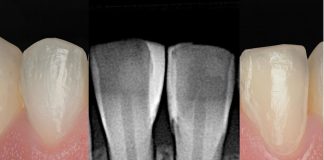
A clinical case by our Community member Dr Mohammed Haji
This article and its content are published under the Author’s responsibility as an expression of the Author’s own ideas and practice. Styleitaliano denies any responsibility about the visual and written content of this work.
Direct composite veneers are a popular and minimally invasive cosmetic dentistry procedure aimed at enhancing the appearance of a patient’s teeth. They involve the application of a tooth-colored resin directly onto the tooth’s surface to improve its shape, color, and overall aesthetics. This non-invasive approach is a versatile solution for a range of dental imperfections, from minor chips and stains to slightly misaligned teeth. Direct composite veneers offer several advantages when compared to their indirect counterpart, porcelain veneers. In this manner, this article showcases the importance of direct composite veneers on the anterior region.



Fig.1
In the initial scenario, a 35-year-old woman arrived at the dental clinic seeking assistance for her teeth, which had several gaps and were shorter than desired. She expressed her desire for a brighter, more noticeable smile, with teeth that appeared slightly whiter.

Fig.2
A slight proclination is noticeable in both canine teeth, along with a crack on the facial surface of the upper right central incisor and a peg-shaped upper right lateral incisor.

Fig.3
Rubber dam placement with open dam technique.

Fig.4
Mamelons were crafted and the composite was adapted to the facial surface using the LM Arte Solo Anterior (LM, powered by StyleItaliano).


Fig.5
Create a curve on one side of the transparent matrix to form a proximal wall.

Fig.6
Shaping step.

Fig.7
Utilizing a Lucida DiaShine polishing technique.

Fig.8
The final polishing was accomplished using the Lucida polishing system by StyleItaliano. Employing a progressive polishing method is essential to prevent any harm to the texture and surface qualities of the restoration.


Fig.9
The recipe included using Soflex finishing discs by Solventum and the Enhance bur for the pre-polishing step. Additionally, FLEXI-D polishing discs by EVE were employed for creating transitional line angles and polishing the proximal surface.


Fig.10
Before and after with rubber dam.

Fig.11
Frontal view of the final situation.

Fig.12
Lateral view of the final situation.

Fig.13
Photo with contraster to see the incisal edges, transitional line angles, incisal embrasures and textures more accurately.

Fig.14
Correction of midline and matching the shade with her lower teeth.

Fig.15
Healthy gingiva without swelling or gingivitis.

Fig.16
Checking the phonetic for the patient.

Fig.17
Before and after with lip retracted.

Fig.18
Difference was clearly seen and the patient was satisfied with the final outcome.
Conclusions
These days, dentists can create stunning smiles while conserving tooth structure. Balancing biological, aesthetic, and functional considerations to meet patient needs can be challenging. The guiding principle is to emulate nature, understanding its look and feel.
Bibliography
- Ortensil , Sigari G, La Rosa GR, Ferri A, Grande F, Pedullà E. Digital planning of composite customized veneers using Digital Smile Design: Evaluation of its accuracy and manufacturing. Clinical and Experimental Dental Research. 2022 Apr;8(2):537-43.
- Manauta J, Salat A. Layers, An atlas of composite resin stratification. Quintessence Publishing Co; 2012.
- Hardan L, Bourgi R, Kharouf N, Mancino D, Zarow M, Jakubowicz N, Haikel Y, Cuevas-Suárez CE. Bond strength of universal adhesives to dentin: A systematic review and meta-analysis. Polymers. 2021 Mar 7;13(5):814.
- Devoto W, Saracinelli M, Manauta J. Composite in everyday practice: how to choose the right material and simplify application techniques in the anterior teeth. Eur J Esthet Dent. 2010 Mar 1;5(1):102-24.
- Devoto W, Pansecchi D. Composite restorations in the anterior region: clinical and aesthetic performances. Practical Procedures & Aesthetic Dentistry: PPAD. 2007 Sep 1;19(8):465-70.