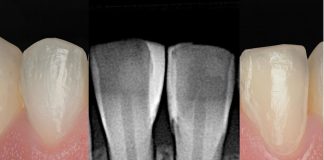
A clinical case by our Community member Dr Mustafa Ali
This article and its content are published under the Author’s responsibility as an expression of the Author’s own ideas and practice. Styleitaliano denies any responsibility about the visual and written content of this work.
The development of technology and the continuous scientific research on materials and techniques allow the dentist today to simplify the daily clinical practice, obtaining predictable and performing result.
In anterior teeth, the outline, light reflective areas, surface texture, and gloss are the keys for obtaining a natural shape. In this article, the essential guidelines for a natural direct composite restoration was described.

Fig.1
Close-up view showing multiple class 3 and class 5 carious lesions with old overhanging composite restoration.

Fig.2
A patient visited the dental office asking for an aesthetic solution for her smile. She complained about unsatisfactory old composite, overhanging, and color changed with multiple carious lesions in upper anterior segment. She asked for more harmonious smile.

Fig.3
Rubber dam isolation was done in an attempt to have a clean field from moisture. Clamp B4 was used for better retraction of the dam. Then, the caries and the overhang filling were removed in both central incisors. Next, sandblasting with 25 um aluminum oxide was used.

Fig.4
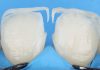
Double sectional matrix bands to restore proximal area between 2 centrals.

Fig.5
After restoring the right central, the first band was removed and the second band was kept to get a tight contact. Body shade A2 was used to restore class 3 and 5.

Fig.6
Sectional matrix was used to restore the distal walls in both central incisors and body shade composite was used to cover the labial surface, with enamel shade as a final layer.

Fig.7
The old filling and carious lesion in laterals and canine were removed.

Fig.8
Lateral view of the smile (close-up view).

Fig.9
Immediate result after contouring, finishing, and polishing.

Fig.10
Final result after rubber dam removal. The dentist and the patient were very happy with the final result.
Conclusions
Adhesive direct restorations are a great source to manage frequent clinical situations. Nowadays, new techniques, instruments, and materials can help dentistry in term of precision and aesthetic aspects. A unique instrument known as applica (LM, powered by Styleitaliano) was used for composite layering application.


Bibliography
-
- Vanini L (1996). Light and color in anterior composite restorations. Pract Periodont Aesthet Dent 8:673-682. Duarte S, Perdigão J, Lopes M (2003). Composite resin restorations Natural aesthetics and dynamics of light. Pract Proced Aesthet Dent 15:A-H.
- Perdigão J (2010). Dentin/Enamel bonding. J Esthet Restor Dent 22:82-85.
- Devoto W, Saracinelli M, Manauta J. (2010). Composite in everyday practice: how to choose the right material and simplify application techniques in the anterior teeth. Eur J Esthet Dent Spring;5(1):102-24.
- Perdigão J, Sezinando A, Monteiro PC. (2012). Laboratory bonding ability of a multi-purpose dentin adhesive. Am J Dent Jun;25(3):153-8.
- Paolone G, Orsini G, Manauta J, Devoto W, Putignano A. (2014). Composite shade guides and color matching. Int J Esthet Dent Summer;9(2):164-82.
- Manauta J, Salat A, Layers, an Atlas of composite resin stratification, Quintessence 2012.
- Manauta J, Salat A, Putignano A, Devoto W, Paolone G, Hardan LS. Stratification in anterior teeth using one dentine shade and a predefined thickness of enamel: a new concept in composite layering-Part II. Odontostomatol Trop. 2014 Sep;37(147):5-13.
- Betrisey E, Krejci I, Di Bella E, Ardu S. The influence of stratification on color and appearance of resin composites. Odontology. 2015 Feb 5.
- Gönülol N, Yilmaz F. J. The effects of finishing and polishing techniques on surface roughness and color stability of nanocomposites. Dent. 2012 Dec;40 Suppl 2:e64-70.