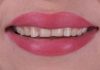
A clinical case by our Community member Dr. Silvana Thering
This article and its content are published under the Author’s responsibility as an expression of the Author’s own ideas and practice. Styleitaliano denies any responsibility about the visual and written content of this work.
With aligner-assisted space management and modern ceramic materials, this article presents a conservative and predictable solution for managing worn dentitions.

Fig.1
A 35-year-old male presented in 2020 with moderate enamel and dentin wear affecting the anterior teeth. The patient had already noticed esthetic changes. Given his young age and the unclear etiology, the tooth wear was classified as severe. His chief complaint was to address the wear in the lower anterior teeth and to improve the overall esthetics, without a specific request for whiter teeth.

Fig.2
The maximal intercuspidation position shows already a tendency to deep bite, because of the dental wear. It was decided to use aligners to obtain the missing restorative space in the frontal area.

Fig.3
The maximal intercuspidation position after aligner therapy (18 weeks). The overbite was not increased.

Fig.4
Prosthetic space was obtained in maximal intercuspidation position in the frontal area using aligner therapy.

Fig.5
Digital wax-up.

Fig.6
Feldspathic ceramic chip for restoring the tip of the lower left canine. The dry try-in. All incisors both upper and lower jaw received such a ceramic chip.

Fig.7
Adhesive cementation protocol: rubber dam isolation, sandblasting, orthophosphoric acid etching, adhesive application and protection of the neighboring teeth with teflon tape, placement of the ceramic chips with the resin cement on the lower left canine.

Fig.8
Frontal view of the maxilla: after the aligner therapy, the mock-up, the rounded incisal edges, the ceramic chips in place.

Fig.9
Frontal view of the mandible: after the aligner therapy, the mock-up, the rounded incisal edges, the ceramic chips in place.

Fig.10
Static occlusal contacts. Comparison of the digitally planned contacts and the final occlusal contacts after adhesive cementation.

Fig.11
Palatal view of the maxilla after the adhesive cementation of the ceramic chips.

Fig.12
Smile close-up after the aligner therapy.

Fig.13
Smile close-up with the final outcome.

Fig.14
Frontal view at 3 years recall.
Conclusions
Advances in ceramic materials and interdisciplinary collaboration now support conservative treatment of worn dentitions. The orthodontic-assisted no-preparation technique is predictable, efficient, well tolerated by patients, and preserves natural tooth structure.
Bibliography
- Vaupel JW. Biodemography of Human Ageing. Nature 2010;464(7288):536-542.
- Schlueter N, Luka B. Erosive tooth wear – A review on global prevalence and on its prevalence in risk groups. Br Dental J 2018;224(5):364-370.
- Debora R. Vilaboa et al.. Tooth Wear The Quintessential Challenge. Quintessence Publishing 2023.
- Gresnigt M, Ozcan M. Esthetic rehabilitation of anterior teeth with porcelain laminates and sectional veneers. J Can Dent Assoc. 2011;77:b143.
- Francesco De Angelis, Camillo D’Arcangelo, Roberta Angelozzi, Mirco Vadini. Retrospective clinical evaluation of a no-prep porcelain veneer protocol. J Prosthet Dent. 2023 Jan;129(1):40-48.
- Camillo D’Arcangelo, Mirco Vadini, Maurizio D’Amario, Zaccheo Chiavaroli, Francesco De Angelis. Protocol for a new concept of no-prep ultrathin ceramic veneers. Journal of Esthetic and Restorative Dentistry. 2017;30(8).
- Pascal Magne, Joseph Hanna, Michel Magne. The case for moderate „guided prep“ indirect porcelain veneers in the anterior dentition. The pendulum of porcelain veneers preparation: from almost no-prep to over-prep to no-prep. The European journal of Esthetic Dentistry 2013;8(3).
- Amélie Karine Jacques Mainjot, Carole Charavet. Orthodontic-assisted one step- no prep technique: A straightforward and minimally-invasive approach for localized tooth wear treatment using polymer-infiltrated ceramic network CAD-CAM prostheses. J Esthet Restor Dent. 2020 Oct;32(7):645-661.
- Oudkerk J, Sanchez C, Grenade C, Vanheusden A, Mainjot A. The One-step No-prep technique for non-invasive full-mouth rehabilitation of worn dentition using PICN CAD-CAM restorations: Up to 9-year results from a prospective and retrospective clinical study. Dent Mater. 2025 Apr;41(4):414-424.