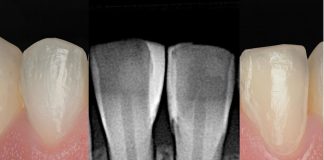
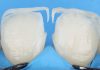
In compromised posterior teeth requiring indirect restorations, the build-up phase is essential to restore lost dental structure, protect the pulp–dentine complex, and create a suitable substrate for the final prosthetic preparation. When deep carious lesions are associated with cold sensitivity, Biodentine XP may represent a useful option as a bioactive dentine substitute. Its biological properties, sealing ability, and calcium ion release support its use in deep areas close to the pulp, also when the clinician decides to manage the case in two appointments.
In this context, Biodentine XP can be used during the first visit to replace deep dentine, reduce postoperative sensitivity, and protect the pulp before the definitive restorative phase. After the initial setting and maturation period, the tooth can be re-entered in a second appointment for adhesive build-up completion, preparation, impression or scanning, and final indirect restoration.
This clinical case describes a bio-bulk-fill build-up protocol using Biodentine XP in a compromised posterior tooth requiring an indirect adhesive restoration.

Fig.1
The patient reported cold sensitivity in the upper right first molar. The preoperative radiograph showed an old incongruous and fractured amalgam restoration associated with secondary caries. After removal of the previous restoration, the clinical view revealed an extensive and deep carious lesion involving the remaining dental substrate.

Fig.2
After complete removal of the carious tissue, a very deep cavity was obtained without pulp exposure. Considering the need for an indirect overlay restoration to rehabilitate the tooth, Biodentine XP was placed to seal, protect, and fill the entire cavity up to the occlusal surface. This approach was selected to monitor the resolution of symptoms and confirm the maintenance of pulp vitality before proceeding with a second appointment for tooth preparation and definitive indirect restoration.


Fig.3
After 30 days, the patient returned for the overlay preparation. All symptoms had completely resolved, and the tooth showed a positive response to sensitivity testing, confirming the maintenance of pulp vitality before proceeding with the indirect restorative phase.

Fig.4
Clinical image of the prepared tooth for the indirect overlay restoration. Biodentine XP can be observed confined within the enamel margins and incorporated into the preparation design, acting as a suitable substrate for both the build-up phase and the subsequent adhesive cementation of the overlay.

Fig.5
The analog impression confirms that, after setting and maturation, Biodentine XP was stable and well integrated within the dental substrate, allowing accurate reproduction of the preparation margins and supporting the subsequent fabrication of the indirect overlay restoration.

Fig.6
The composite overlay was adhesively cemented to restore tooth morphology and function. The choice of a composite indirect restoration allows a more conservative and easily manageable approach in the event that future access to the pulp–dentine complex is required, considering that the tooth remained vital.

Fig.7
Final clinical appearance one month after adhesive cementation of the composite overlay. The tooth remained asymptomatic and showed a positive response to vitality testing, confirming the maintenance of pulp vitality after the indirect restorative procedure.

Fig.8
The postoperative radiograph shows Biodentine XP placed in close proximity to the pulp chamber. The margins of the indirect restoration appear well adapted, supporting a functional rehabilitation of the tooth. The tooth remained vital, with no radiographic signs of periapical pathology.
Conclusions
After complete caries removal, the cavity showed a very limited remaining dentine thickness without pulp exposure. For this reason, indirect pulp capping with Biodentine XP represented a conservative approach to preserve pulp vitality and protect the pulp–dentine complex.
Although single-visit restoration is generally considered the preferred approach to ensure immediate coronal sealing and support the success of vital pulp therapy, it is not always possible to complete the definitive rehabilitation in one appointment, especially in compromised teeth requiring indirect restorations. In such cases, Biodentine XP offers the clinician the possibility to seal and fill the deep cavity, protect the pulp–dentine complex, and safely postpone the definitive restorative phase to a second appointment.
A pragmatic shift in vital pulp therapy is the possibility of maintaining the pulp-capping material in situ, rather than removing or replacing it during the restorative phase. Once set, Biodentine XP becomes integrated with the pulp–dentine substrate and can be incorporated into the build-up design, allowing the clinician to proceed with adhesive procedures and indirect restoration cementation.
At follow-up, the tooth remained asymptomatic and vital, with no radiographic signs of periapical pathology. This case suggests that Biodentine XP may be a useful bio-bulk-fill material for build-up procedures in compromised posterior teeth requiring indirect adhesive restorations.
Bibliography
- Cassiano Ferraz D, Rahhal JG, Dotto MEP, Ferreira LA, Sipert CR, Letra A, Silva RM, de Souza LC. Physicochemical and biological properties of Biodentine XP, Endosequence RRM, and Bio-C Repair cements. J Endod. 2025;51:1109–1117.
- Frankenberger R, Koch A, Plohmann L, Beck-Broichsitter B, Becker S. The outcome of old-school indirect pulp capping over 40 years: a practice-based retrospective evaluation. Dent J. 2025;13:182.4.
- Hardan L, Mancino D, Bourgi R, Alvarado-Orozco A, Rodríguez-Vilchis LE, Flores-Ledesma A, Cuevas-Suárez CE, Lukomska-Szymanska M, Eid A, Danhache ML, Minoux M, Haïkel Y, Kharouf N. Bond Strength of Adhesive Systems to Calcium Silicate-Based Materials: A Systematic Review and Meta-Analysis of In Vitro Studies. Gels. 2022 May 18;8(5):311. doi: 10.3390/gels8050311. PMID: 35621609; PMCID: PMC9141246.
- Hernández-Cabanillas JC, Hardan L, Cuevas-Suárez CE, Olivares-Acosta I, Dang AT, Tosco V, Kharouf N, Lukomska-Szymanska M, Haikel Y, Bourgi R. Comparative evaluation of the physicochemical and biological properties of calcium silicate-based pulp capping materials. Front Dent Med. 2025 Dec 12;6:1737941. doi: 10.3389/fdmed.2025.1737941. PMID: 41458174; PMCID: PMC12741156.
- Tosco V, Monterubbianesi R, Montagna P, Orilisi G, Vitiello F, Song H, Putignano A, De Santis D, Orsini G. Vital pulp therapy: a three-year clinical case series on regenerative potential and adhesive restoration strategies. Regenesis Repair Rehabil. 2026;2(2):99-111.