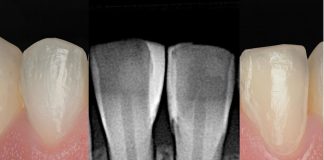
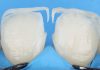
A clinical case by our Community member Dr. Mohammed Haji
This article and its content are published under the Author’s responsibility as an expression of the Author’s own ideas and practice. Styleitaliano denies any responsibility about the visual and written content of this work.
Exemplary anterior restorations serve as a testament to a dental professional’s expertise. Anterior tooth procedures primarily involve the direct application of composite resins. The clinician’s skill in achieving a lifelike anatomical contour and seamless color integration with adjacent dentition is crucial for obtaining a favorable aesthetic outcome using minimally invasive procedures. Such outcomes are readily noticeable and appreciated by patients. This article outlines the procedural steps for performing a natural-looking direct composite restoration on anterior teeth.


Fig.1
Initial Situation: A 26-year-old female patient presented to the clinic seeking a solution for her diastema and worn teeth. She expressed a desire for a brighter and more prominent smile.

Fig.2
Capture a mini aesthetic photograph to assess key parameters, including the zenith point, gingival contour, axial inclination, and incisal embrasures in detail. This step ensures a precise evaluation before proceeding with the restorative approach.

Fig.3
Check the occlusion and canine guidance.

Fig.4
Isolate her teeth with a rubber dam in a split-dam technique to get-rid of lips, tongue and saliva.

Fig.5
Creating mamelons by using LM ARTE FISSURA instrument in a free modelling technique.

Fig.6
Create a well-defined proximal wall using a transparent matrix and a Solo Anterior instrument, then use the pull-down technique for composite adaptation, followed by blending with a composite brush for a seamless finish.
Video.7
First, create a curve on one side of a transparent matrix, position it on the proximal side, place composite between the matrix and facial surface, adapt it using a compo-brush, and pull down the matrix as shown in the video, while recording the procedure with the Smile Lite MDP device.



Fig.8
In the shaping stage you can correct any irregularities and depressions by adding enamel shade composite.

Fig.9
Use 3M™ Sof-Lex™ finishing discs by Solventum and Enhance bur for the pre-polishing step, followed by FLEXI-D polishing discs (EVE) to refine transitional line angles and Epitex polishing strips for polishing proximal surfaces. Finishing stage was done with Lucida DiaShine for the final polish.

Fig.10
After one week, the patient came back for follow-up.

Fig.11
Correction of the diastema and smile line.

Fig.12
Layering technique.

Fig.13
The location of the mamelons and transitional line angles.

Fig.14
Before and after.

Fig.15
Changing the shape and shade.
Conclusions
Adhesive direct restorations serve as an invaluable resource in addressing a multitude of prevalent clinical scenarios. Through the skillful utilization of composite materials, the restoration of teeth becomes not only feasible but also remarkably precise, consistently yielding aesthetically pleasing outcomes. Moreover, the integration of LM Tools has emerged as an indispensable asset, offering flawless assistance in various clinical situations, further enhancing the overall efficacy of dental procedures.
Bibliography
- Hardan L, Bourgi R, Kharouf N, Mancino D, Zarow M, Jakubowicz N, Haikel Y, Cuevas-Suárez CE. Bond strength of universal adhesives to dentin: A systematic review and meta-analysis. Polymers. 2021 Mar 7;13(5):814.
- Devoto W, Saracinelli M, Manauta J. Composite in everyday practice: how to choose the right material and simplify application techniques in the anterior teeth. Eur J Esthet Dent. 2010 Mar 1;5(1):102-24.
- Devoto W, Pansecchi D. Composite restorations in the anterior region: clinical and aesthetic performances. Practical Procedures & Aesthetic Dentistry: PPAD. 2007 Sep 1;19(8):465-70.
- Manauta J, Salat A. Layers, An atlas of composite resin stratification. , Quintessence Books, 2012. 3. Dietschi D. Optimizing smile composition and esthetics with resin composites and other conservative esthetic procedures.