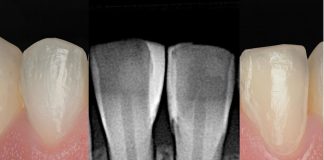
Multiple diastema closure cases can be extremely challenging. Firstly, we work in an aesthetic area, which is important for the patient, and all imperfections are clearly visible. The second problem is matrix stability. Without adjacent contact points, it’s hard to fix the matrix in place. Additionally, placing the matrix limits our vision, making it easy to create asymmetrical teeth. When the patient assesses our work, two things are most important: color and symmetry. Thanks to new universal materials (such as Filtek Universal Restorative from Solventum), it’s easy to blend with the natural tooth and achieve an aesthetic effect using even a single shade. Thanks to new monomers, this material has low shrinkage, allowing us to work faster. So, how do we deal with symmetry?



Fig.1
This female patient expressed interest in minimally invasive smile correction. Addressing multiple diastemas that needed closure necessitated a special approach.

Fig.2
An easy method to determine the amount of material needed is by using a periodontal probe. You can measure the entire distance between the distal ridges, divide it by two, and obtain the perfect width for the final restoration. The challenge lies in stabilizing the matrix in the required position.

Fig.3
The first step involves enamel preparation. To ensure proper adhesion, the enamel is initially sandblasted using a microetcher with alumina oxide (27 µm), followed by etching for 30 seconds. Subsequently, I utilize ScotchBond Universal Plus adhesive for simple and predictable adhesion.


Fig.4
Before placing any matrix, the first step is to position a small ball of composite in the proximal area. The size of the ball is measured using a periodontal probe to match the width for the final restoration based on the measurements taken.

Fig.5
Once polymerized, this ball serves as an ideal anchor to secure the matrix (such as Unica Anterior from Polydentia) in place. Even with limited visibility after placing the matrix, you can be confident in achieving the desired width.

Fig.6
Injection molding with Filtek Universal Restorative B1 is employed. Thanks to the advancements in monomers and low shrinkage properties, it is possible to utilize the single-shade single-mass technique.

Fig.7
Thanks to the design of Unica, which features an open shape from the palatal side, you can readily inspect and, if necessary, add material from the palatal aspect as needed.

Fig.8
The proximal area is meticulously shaped and smoothed out, all thanks to the precision of the matrix. With the aid of the ball, the desired tooth width is effortlessly attained.

Fig.9
The same steps are repeated for the adjacent tooth, ensuring consistency and uniformity in the restoration process.

Fig.10
Both central teeth exhibit the same width and proximal symmetry, owing to the precise shaping facilitated by the Unica Anterior matrix.

Fig.11
The steps were repeated for the remaining anterior teeth.

Fig.12
The single shade, universal composite restorations were sculpted using the Essential Shape technique for a harmonious and natural appearance.

Fig.13
Final inspection was conducted after removing the rubber dam to ensure symmetrical shape and color matching achieved through the use of a single shade universal composite and Unica Anterior matrices.

Fig.14
Before and after comparison reveals multiple diastemas closed in under 40 minutes, employing simple steps to attain symmetry of shape and color—crucial aspects for our patients in such cases.

Fig.15
The final comparison showcases the transformation from before to after, highlighting the successful closure of multiple diastemas and the achievement of a harmonious smile with enhanced symmetry and color.
Conclusions
Simplification is paramount in our daily practice, enabling better repeatability of procedures and more predictable outcomes. Dealing with multiple diastemas presents technical and aesthetic challenges. Therefore, it’s crucial to prioritize elements that are most significant for our patients. They highly value symmetry in both shape and color. However, achieving the proper shape with an unstable matrix can be arduous and frustrating. Hence, the proposed clinical “trick” aims to streamline our daily practice, offering a solution to this challenge.
Bibliography
- de Abreu JLB, Sampaio CS, Benalcázar Jalkh EB, Hirata R. Analysis of the color matching of universal resin composites in anterior restorations. J Esthet Restor Dent. 2021 Mar;33(2):269-276.
- Dixon DL. Overview of articulation material and methods for the prosthodontic patient. J Prosthet Dent. 2000;2:235-247.
- Baldissera RA, Corrêa MB, Schuch HS, Collares K, Nascimento GG, Jardim PS, Moraes RR, Opdam NJM, Demarco FF. Are there universal restorative composites for anterior and posterior teeth? J Dent. 2013;PMID: 24001506.
- Okeson JP. Tooth Wear Management of Temporomandibular Disorders and Occlusion. 6th edition. St Louis: Mosby; 2008. 245-247.
- Ghazal M, Albashaireh ZS, Kern M. Wear resistance of nanofilled composite resin and feldspathic ceramic artificial teeth. J Prosthet Dent. 2008;100(6):441-448.
- Monteiro P. Essential Shape. The key to a tooth-like restoration. 2020, styleitaliano.org
- Vanini L, D’Arcangelo C, Indelli P, Bellizzomi P. Estetica, funzione, postura. Year not provided.