A clinical case by our Community member Dr. Sandra Hulac
This article and its content are published under the Author’s responsibility as an expression of the Author’s own ideas and practice. Styleitaliano denies any responsibility about the visual and written content of this work.
No-prep direct composite veneers are a popular treatment option in everyday practice. For younger patients, they are often the most suitable (and sometimes the only) option. Increasingly, adult patients are also requesting this non-invasive treatment, possibly influenced by negative online reviews of porcelain veneers, which highlight issues such as over-preparation of teeth and the need for costly remedial work.
Achieving high-quality results with composite veneers requires substantial practice. Even experienced practitioners find that completing a 10-unit case can take most of the working day. Recently, a new technique using flowable composite in an injection molding method has gained popularity, significantly reducing chair-side time for composite veneering cases. Although the aesthetic results of injectable veneers are good, they may lack the polychromaticity of layered composite veneers, and some flowable composites are reported to have issues with low value.
Combining a traditional layering technique with a final layer applied using a clear matrix obtained from a wax-up can greatly accelerate the veneering process without compromising aesthetic results.

Fig.1
Pre-treatment full smile: Patient was seeking cosmetic improvement.

Fig.2
Pre-treatment MIP: Multiple diastemas and peg shaped laterals.

Fig.3
Pre-treatment lip in repose and 12 o’clock images demonstrate insufficient display.

Fig.4
Smile Design: Includes lengthening in order to achieve correct proportions and close diastemas. Patient is planned for layered composite veneers on teeth 13-23.

Fig.5
Wax-up following parameters established by our smile design. This wax up should ideally be done by the dentist in order to have full control over the outcome but can as well be done by a dental technician analogical or digital way.

Fig.6
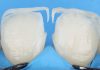
As in the injection molding technique, two matrices per arch are created to use the time-saving “alternating tooth” method. These matrices are cut to facilitate the pressing of the final layer, excess removal, and the placement of a rubber dam for moisture control.

Fig.7
The rubber dam is placed, and flow buttons on the teeth help keep the ligatures in place. Additionally, a lingual matrix is fabricated.

Fig.8
Teeth not involved in the “first round” of treatment are isolated with Teflon tape. The palatal shell, dentin layer, and effect enamels or stains are applied as usual. After layering, it is recommended to smooth the entire labial surface with diamonds and reapply the bonding agent. This step ensures a smooth surface for pressing the final layer, helping to avoid the entrapment of air bubbles.

Fig.9
Enamel shade composite is applied to the matrix and then transferred into the mouth. Any excess can be easily removed before curing, as the matrices are cut to facilitate this process.

Fig.10
During the first and second rounds of treatment, any excess composite not removed before curing should be trimmed with a #12 blade. Primary anatomy will typically require minimal correction.

Fig.11
Post-treatment full smile: Patient is very pleased with the result.

Fig.12
Post-treatment MIP: The diastemas are closed, proportions are improved, and the composite restorations integrate seamlessly with the natural dentition.

Fig.13
Post-treatment lip in response and 12 o’clock images demonstrate improved reveal.

Fig.14
Final result.
Conclusions
Layered composite veneers are a wonderful and responsible treatment option for many patients, though they are time-consuming. In this practitioner’s experience, combining layering with the pressing on of the final layer can reduce chair-side time by approximately 40 percent.
Bibliography
- Coachman C ,De Arbeola L, Mahn E. An Improved direct injection technique with flowable composites. A digital workflow case report. Oper Dent.,2020;45(3):235-242.
- Rufenacht CR, Fundamentals of Esthetics. Berlin: Quintessence, 1990:67-134.
- Sterrett JD, Oliver T et al. Width/lenght ratios of normal clinical crowns of the maxillary anterior dentition in man. J Clin Periodontol 1999;26: 153-157.
- Terry DA,Geller W et al. Anatomical form defies colour: function, form and aesthetics. Pract Proced Aesthet Dent.2002 Jan-Feb;14(1):59-57.
- Dietschi D,Ardu S,Krejci I. A new shading concept based on natural tooth colour applied to direct composite restorations. Quintessence Int 2006,37:91-102.
- Dietschi D, Fahl N Jr. Shading concepts and layering techniques to master direct anterior composite restorations: A systematic literature review and critical appraisal. Int J Esthet Dent 2019;14:252-270.