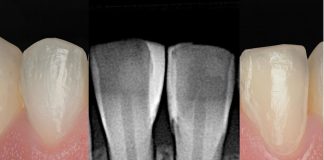
Clinical Case in collaboration with Ali Asadov (DT)
Modern dentistry has entered a new era, where restoration isn’t just about rebuilding, but about elevating. Today’s clinicians are equipped with advanced materials that fuse strength with artistry, enabling outcomes that are as functional as they are visually striking.
Between these materials, zirconia has taken center stage, admired for its robust mechanical properties and lifelike beauty. Its adaptability makes it a cornerstone in addressing complex cases that demand both precision and aesthetic finesse.
This case report explores the transformative impact of zirconia in a difficult case, demonstrating how an expert dentist and material science can harmonize to deliver exceptional results, where elegance and endurance meet.


Fig.1
A 28 year old patient visited our clinic seeking an esthetic improvement.
On examination, the existing veneers and crowns which exhibited translucency at the incisal edges were not esthetically pleasant. Additionally, the veneers had been placed over previously restored teeth in compromised positions, leading to an unsatisfactory esthetic outcome.
After thorough evaluation, a comprehensive treatment plan was proposed: removal of the existing restorations, elimination of underlying caries, and preparation of the teeth for new zirconia crowns.
The patient agreed to proceed with this approach, aiming for enhanced function and a more harmonious smile.

Fig.2
Following the removal of existing veneers, crowns, and carious lesions, the teeth were initially restored and carefully prepared for temporary crowns.
These provisionals, based on a digital smile design, allow for an esthetic preview of the final outcome while providing an opportunity for gingival tissue to stabilize prior to the definitive impression.
Video.1
This video showed the prepared upper teeth and a comprehensive digital smile design developed using Exocad, the advanced software tool, ensuring a tailored and highly accurate treatment workflow that aligns perfectly with the patient’s unique oral profile.

Fig.3
PMMA temporary crowns were fabricated, evaluated, adjusted, and provisionally cemented.
The patient refused any surgical intervention to correct the gingival issue affecting tooth number 11, noting that the gingival margin is not visible within her natural smile line.

Fig.4
The patient’s portraits, taken before and after placement of the provisional restorations, reveal a big transformation in her smile. This visible improvement brought the patient great satisfaction and reinforced her decision to move forward with the proposed treatment plan.
The mock-up proved to be a valuable tool, offering both the patient and clinician a clear preview of the anticipated final outcome and confirming the effectiveness of the smile design.

Fig.5
A conservative preparation technique was carried out with an emphasis on preserving healthy dental structure.
One week following the placement of the PMMA crowns, the gingival tissues demonstrated excellent healing.
Retraction cords were carefully positioned to ensure optimal access and visibility of the margins, and a high-precision digital impression was taken using the Helios 500 intraoral scanner (Eighteeth, China).

Fig.6
The zirconia restorations were milled and stained by the dental technician based on the initial smile design, which had been carefully reviewed and approved by both the patient and clinician.
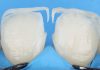
To verify precise adaptation, the crowns were first placed on a 3D-printed model prior to clinical delivery.
Fabricated using Ezneer Zirconia (Aidite, Qinhuangdao, China), the crowns underwent internal surface treatment with Biomic LiSi Connect (Aidite, Qinhuangdao, China).

Fig.7
The Biomic LiSi specialized layer, applied before sintering of the Zirconia, significantly improves bonding performance, offering a glass-ceramic-like interface that enhances the bonding quality.

Fig.8
After bonding, the zirconia crowns demonstrated excellent esthetic qualities and seamless integration, visibly enhanced under various lighting conditions. The interplay of staining and contour, highlighted the natural appearance of the restorations, underscoring their harmony with the surrounding dentition.

Fig.9
The final restorations, viewed from multiple angles, demonstrate seamless integration with the surrounding dentition. Their natural contours and harmonious appearance highlight the precision of the work and the esthetic success of the treatment.

Fig.10
This image highlights the harmonious aesthetic integration between the lips and teeth, showcasing the natural balance and pleasing contours achieved through the restorations.

Fig.11
The patient’s portraits, captured before and after treatment, reveal a remarkable transformation in her facial appearance, particularly in the harmony and brightness of her smile.
The final zirconia restorations were carefully designed to replicate the esthetics and contours of the provisional crowns (portrait in the middle) preserving the validated mock-up that had already brought the patient satisfaction.
This continuity between the temporary and definitive restorations played a pivotal role in ensuring a predictable and pleasing outcome.
Video.2
In this video the smile after treatment is presented.
The details of the restorations can be seen perfectly, knowing that this video and most of the pictures in this article are taken with a smartphone and the SmileLite MDP (SmileLine, St. Imier, Switzerland) as lighting system.

Fig.12
The before and after pictures of the patient reveal a dramatic transformation in her smile.
What was once uneven and structurally compromised now exudes balance, brightness, and a lifelike harmony.
The final restorations not only elevated the esthetic symmetry but also brought refinement to tooth shape and alignment, an outcome that speaks to the precision and artistry behind the entire treatment journey.
Conclusions
This case tells the story of more than just restored teeth, it’s about reclaiming a smile and the confidence behind it.
With the help of modern tools and thoughtful planning, the transformation unfolded through zirconia restorations that didn’t just perform, they inspired.
Crafted for strength and designed for beauty, the results speak volumes: a smile that feels authentic and looks effortless.
Behind each step was a blend of science, creativity, and compassion, all working together to give the patient not only functional improvement but a renewed sense of self.
It’s a powerful reminder that dentistry, at its finest, reaches beyond the clinical, it touches lives.
Bibliography
- Zhong, C., & Wang, X. (2024). Advancements and challenges in the application of zirconia ceramics for dental restorations. Ceramics-Silikáty, 68(4), 610–623.
- Nezir, M., Özcan, S., Atilla, A. O., & Evis, Z. (2025). A review of zirconia-based dental materials. Journal of the Australian Ceramic Society, 61, 235–249.
- Alqutaibi, A. Y., Ghulam, O., Krsoum, M., Binmahmoud, S., Taher, H., Elmalky, W., & Zafar, M. S. (2022). Revolution of current dental zirconia: A comprehensive review. Molecules, 27(5), Article 1699.