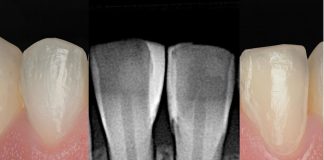
A clinical case by our Community member Dr. Simona Chirico
This article and its content are published under the Author’s responsibility as an expression of the Author’s own ideas and practice. StyleItaliano denies any responsibility about the visual and written content of this work.
Bulk-fill composites have gained increasing popularity in recent years due to their favorable mechanical performance, functional reliability, and excellent esthetic outcomes. The following case report illustrates a direct restoration performed in the third quadrant, highlighting the clinical steps and considerations involved in achieving an optimal result.

Fig.1
Initial clinical and radiological situation. The patient presented multiple carious lesions and old incongruous restorations involving elements 35,36,37. Therefore the proposed treatment plan was to perform direct restorations.

Fig.2
Isolation of the third quadrant under rubber dam.

Fig.3
Initial exploration of the cavities.

Fig.4
The cavities were prepared for direct restoration: class II on 35 and 36; class I on 37.

Fig.5
Adhesion protocols performed: selective pre-etching of the enamel and application of a universal adhesive.

Fig.6
Application of the SimpliShade Bulk Fill Flow composite by Kerr (Orange, California, USA) on the cavity bottom.

Fig.7
Positioning of the sectional matrices for the creation of the marginal ridges of 35 and 36.

Fig.8
Marginal ridges completed.

Fig.9
Cavities were filled in a single increment of SimpleShade Bulk Fill Universal Composite by Kerr (Orange, California, USA), which was adapted, and excess material was removed. The occlusal surfaces were then shaped following The Espresso posterior technique, saving valuable time.

Fig.10
Characterization with brown stains.

Fig.11
Result after removing the rubber dam.

Fig.12
Occlusal check.

Fig.13
Clinical and radiological control after 1 year follow-up.
Conclusions
This clinical case demonstrates the versatility of bulk-fill composites. Their use simplifies direct restorative procedures, ensuring efficiency, predictability, and excellent clinical outcomes. These approaches streamline workflows while maintaining high standards of functionality and aesthetics.
Bibliography
- Chiodera G, Monterubbianesi R, Tosco V, Papini O, Orsini G, Putignano A. Application of Bulk- Fill Composite to Simplify the Cementation of Indirect Restorations: The COMBO Technique. Dent J (Basel). 2024 Jul 29;12(8):239. doi: 10.3390/dj12080239. PMID: 39195083; PMCID: PMC11352567.
- Putignano A, Tosco V, Monterubbianesi R, Vitiello F, Gatto ML, Furlani M, Giuliani A, Orsini G. Comparison of three different bulk-filling techniques for restoring class II cavities: μCT, SEM-EDS combined analyses for margins and internal fit assessments. J Mech Behav Biomed Mater. 2021 Dec;124:104812. doi: 10.1016/j.jmbbm.2021.104812. Epub 2021 Sep 3. PMID: 34500356.
- Refaey HS, Abdelkader SH, Aly YM. Fracture resistance and marginal fit of three different overlay designs using advanced zirconia-reinforced lithium disilicate CAD/CAM material. BMC Oral Health. 2025 Jan 4;25(1):20. doi: 10.1186/s12903-024-05315-1. PMID: 39755589; PMCID: PMC11699763.
- Hardan L, Devoto W, Bourgi R, Cuevas-Suárez CE, Lukomska-Szymanska M, Fernández- Barrera MÁ, Cornejo-Ríos E, Monteiro P, Zarow M, Jakubowicz N, Mancino D, Haikel Y, Kharouf N. Immediate Dentin Sealing for Adhesive Cementation of Indirect Restorations: A Systematic Review and Meta-Analysis. Gels. 2022 Mar 11;8(3):175. doi: 10.3390/gels8030175. PMID: 35323288; PMCID: PMC8955250.