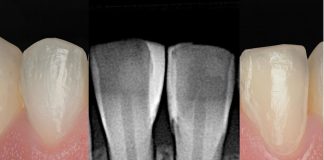
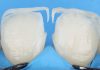
TrollFoil is an articulating foil that significantly differs from the ones I tried in the past in both, ink quality and its innovative project.

Fig.1
It is available in 3 different models:
- 8 Microns (Blue)
- 8 Microns (Red)
- 4.5 Microns (Gray)
Inked on both sides.

Fig.2
Although the marked contact points are clearly defined and are not being removed from saliva and water during operating phases, they can be easily removed at the end of the session with a cotton roller.

Fig.3
How it is made:
Each foil has a plastic frame, and is packaged with a plastic holder.
Side A: you can see the surface of the foil, with the frame attached to the plastic holder.
Side B: the frame is highlighted in Pink, and will be detached from the remaining plastic part (C). This frame allows you to avoid using the dedicated tool to hold the foil, making it possible to simply hold it with your fingers.

Fig.4
By opening the package we will find the foil combined with a plastic support, needed to protect the former. Before using the foil (B), we must separate it from the plastic support (C).

Fig.5
This is how the foil with the frame and the plastic support appear separated.

Fig.6
The frame’s shape allows it to follow the dental arch and not to interfere with the correct bite registration.

Fig.7
Because of the frame, when holding the TrollFoil with your fingers, it remains perfectly stretched without any creases or wrinkles. The pink adhesive material also prevents you from staining your gloves.

Fig.8
If compared to other papers on the market, we notice that only those made of thick material manage to stay in tension, whilst the thinner versions cannot hold the shape adequately.

Fig.9
Placing a foil between the teeth with your fingers is the most practical way.

Fig.10
If preferred, however, a paper holder can be employed. This will also have a very effective grip on the plastic portion.

Fig.11
Traditional ”thin” papers necessarily need a paper holder.

Fig.12
Only in this way can we keep the foil stretched up to the distal portion of the arch.

Fig.13
The thin foil allows us to highlight the real contacts. In order to obtain accurate recordings, it is essential for the foil to be correctly retained by its paper holder.

Fig.14
The traditional paper holder can cause grip problems, especially with thin papers that can slip out.

Fig.15
It can slip out in the mesial part.

Fig.16
Or it can lose its grip in the distal part.

Fig.17
A very useful tip for the bite registration is to ask the patient to chew the paper in a natural way, as he would normally do. In order to do this effectively, it is best to have the foil free from tools such the paper holder, so the client is able to chew properly.

Fig.18
We can place the paper in between the teeth by using either tweezers or a paper holder, and leave the paper to curl up in the mouth while chewing, without the paper holder. Unfortunately, what might happen is that the foil curls up until it creates fake contacts. This can happen as while the foil curls up, it causes the thickness to double or even triple.

Fig.19
If, instead, we use TrollFoil with its plastic frame, we are able to place it into position by holding it with our fingers.

Fig.20
The foil will remain stretched up to the most distal portion.

Fig.21
With two fingers you can easily place it into position.

Fig.22
It remains stretched even when it is not being held.

Fig.23
The patient will then be free to chew, and we will be sure that the paper will remain stretched up to the most distal portion.

Fig.24
The foil is rigid so that the patient can chew without destroying it!
Like a chewing gum, when the film comes, it generates further thickness and creates false occlusal contact points. This is also relevant for the anterior area.

Fig.25
The occlusal contact points marked by TrollFoil are defined and easily visible on all types of materials: natural tooth, composite, amalgam, gold tooth.

Fig.26
Gold tooth on 2.7, composite and natural tooth on 2.6 and zirconia on 2.5

Fig.27
Natural tooth, gold tooth and composite tooth.

Fig.28
Without paper holder

Fig.29
On gold, composite and natural tooth.

Fig.30
It is also perfect on ceramic!

Fig.31
It works very well on the resin of the occlusal plates.

Fig.32
Regardless of the resin used.

Fig.33
When compared to traditional papers they do not get damaged as easily, and we can register an entire arch without changing it.

Fig.34
A record of the contact points throughout the BITE.
Here’s what the foil looks like at the end of the bite calibration:
- TrollFoil is still perfectly capable of recording other information
- the one in the middle is destroyed
- the one on the left can no longer be used.

Fig.35
- TrollFoil is still perfectly capable of recording other information
- the one in the middle is destroyed
- the one on the left can no longer be used.

Fig.36
The red points, made with a 8 microns foil, are clearly visible.

Fig.37
Even on the antagonist teeth that were more humid, we can still clearly notice the red points.

Fig.38
Let’s consider the same quadrant, on which we will work with different papers on the market.
The traditional paper 21 micron doesn’t mark well.

Fig.39
The traditional paper looks like a cardboard. It marks everything, possibly too much.

Fig.40
TrollFoil instead marks very well, also in different moments.

Fig.41
Comparison between the three different papers:
Traditional thin (left), Traditional thick (center), TrollFoil 8 micron (right).

Fig.42
Even in the wet field and with one 2.5 microns foil it is still possible to highlight the contact points. Even while being very thin, TrollFoil marks on both sides.

Fig.43
It also works in very wet surfaces.
Conclusions
TrollFoil is an articulating foil with unique properties:
The ink leaves clear and defined marks on all types of materials, from natural teeth to all material used for direct and indirect restorations.
The plastic frame allows you to grip the foil directly with your fingers, by keeping it stretched, it avoids the use of a paper holder, making the usage more ergonomic.
The fabric of the foil, although thin, is very resistant, one foil allows numerous recordings.
Thanks to this ink we can have very thin papers 8 microns, up to very thin 4.5 microns, always with a precise marking effect on the teeth, on both arches at the same time as it colors on both sides.