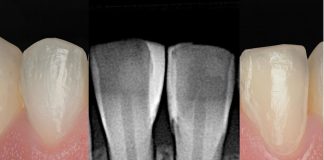
Peg-shaped lateral incisors represent one of the most common developmental anomalies affecting the anterior dentition and can significantly compromise smile aesthetics, symmetry, and patient confidence. Contemporary restorative dentistry increasingly favors minimally invasive approaches capable of preserving healthy dental tissues while delivering highly aesthetic and functional outcomes.
Direct composite restorations have become a preferred treatment option for the management of peg-shaped lateral incisors because of their conservative nature, reversibility, cost-effectiveness, and ability to be completed in a single appointment. Recent advances in adhesive systems, universal shade concepts, and injectable composite technologies have further simplified these procedures while improving predictability and aesthetic integration.
This clinical report illustrates the direct rehabilitation of a peg-shaped lateral incisor using an injectable composite technique with Filtek™ Easy Match Flow and a sectional metal matrix, demonstrating how modern restorative protocols can achieve natural morphology, seamless integration, and excellent aesthetic outcomes with minimal intervention.


Fig.1
In this case, a simplified workflow for the reconstruction of peg shaped laterals is presented. Achieving the correct morphology and shade can often be challenging. This makes the new Filtek™ Easy Match Flowable composites an excellent option, thanks to their pronounced chameleon effect and the ability to inject the material directly into the confined space between the matrix and the tooth. The rubberdam is placed and a buccal composite ball is placed with a flowable composite to retract the rubberdam and save space in comparison to a classic clamp retraction.

Fig.2
For this indication, a Unica Proximal matrix is positioned, as illustrated in the schematic example, leaving adequate space for the papilla while extending deeply into both the buccal and palatal sulci.

Fig.3
After air abrasion with 29-µm aluminum oxide particles, the enamel is etched with phosphoric acid for 10 seconds. Scotchbond™ Universal Plus Adhesive is then applied with a brush and light-cured for 20 seconds. Once the matrix is in place, the injection of Filtek™ Easy Match Flowable can begin. For this case, the Natural shade was selected beforehand by performing a quick intraoral finger-supported mock-up on the peg-shaped lateral incisor.


Fig.4
The extra-fine dispensing tip of Filtek™ Easy Match Flowable allows the material to be delivered as deeply as possible into the space between the matrix and the tooth. This technique minimizes the risk of air entrapment while providing the precision needed to shape the tooth accurately without excessive overfilling.

Fig.5
The first increment is placed and light-cured while supporting the matrix with a finger or an instrument to ensure the development of a well-defined proximal contact.

Fig.6
The mesial matrix is then positioned, again without the need for a wedge. At this stage, the distal wall demonstrates excellent precision, an accurate contact area, and an ideal emergence profile beneath the rubber dam.

Fig.7
Once both proximal walls have been completed, only the buccal surface remains to be restored with the next layer of flowable composite. The restoration is completed in just three precise layers, minimizing the amount of finishing required.

Fig.8
The composite ball used to maintain cervical rubber dam retraction is removed with a scaler, as no etching or bonding procedures were performed during its placement. Finishing begins with a small coarse Sof-Lex™ disc to establish the correct incisal edge length, refine the tooth shape, and define the final line angles. A slow-speed diamond bur is then used to finish the buccal and palatal surfaces.

Fig.9
Polishing is performed using the two-step Sof-Lex™ Spiral polishing system, beginning with the beige spiral.

Fig.10
The polishing sequence is completed using the pink Sof-Lex™ Spiral.


Fig.11
The final luster achieved with the Filtek™ Easy Match Flowable restoration after using only the two-step Sof-Lex™ Spiral polishing system is highly satisfactory, producing a mirror-like surface that blends seamlessly with the surrounding dentition.

Fig.12
Final clinical outcome.
Conclusions
The Filtek™ Easy Match Flowable composite enables the efficient delivery of highly esthetic results when combined with appropriate placement, finishing, and polishing techniques. Because the contralateral lateral incisor was not included in the rubber dam isolation, it serves as a useful reference for evaluating the final shade of the restoration, while recognizing that the underlying peg-shaped tooth remains dehydrated during the procedure. The restorative material’s chameleon effect allows the restoration to adapt naturally, although it may initially appear slightly brighter due to the temporary dehydration of the tooth.


Bibliography
1.Manauta J, Salat A. Layers: An Atlas of Composite Resin Stratification. Quintessence Publishing; 2012.
2.Paolone G, Scolavino S, Gherlone E, Spagnuolo G. Direct Esthetic Composite Restorations in Anterior Teeth: Managing Symmetry Strategies. Symmetry. 2021; 13(5):797.
3.Manauta J, Salat A, Devoto W, Putignano A. Layers 2. Direct composites: the Styleitaliano clinical secrets. Quintessence Publishing. 2022.