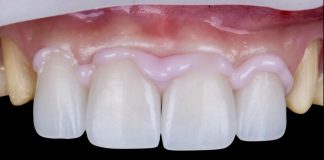
The step-luting technique optimizes the cementation of indirect restorations using dual-cure resin cement, addressing a critical phase in restorative procedures. A 5-second light cure stabilizes the restoration while maintaining the cement in a gel-like state for easy excess removal. After a 20-second wait, a final 40-second light cure ensures complete polymerization, enhancing bond strength and marginal adaptation. The self-curing component guarantees polymerization even in areas with limited light exposure. This technique improves clinical efficiency, reduces stress on the restoration, and ensures long-term stability.
The following clinical case demonstrates the step-by-step fabrication and cementation of an overlay on an endodontically treated molar with a faulty composite restoration.


Fig.1
Initial situation, the patient showed an old unaesthetic composite reconstruction with several cracks on lower first molar. With the compliance of the patient, the treatment plan involved the replacement of the existing composite restoration with an indirect one.

Fig.2
A cross was created to serve as a guide for occlusal reduction and the subsequent preparation for an overlay, utilizing a diamond cylindrical bur. It is preferable to initiate the preparation in the central fossa, progressing along the sulcus in order to achieve an even 2 mm of occlusal reduction in the deepest part.

Fig.3
Preparation steps: first reducing the occlusal surface, followed by the interproximal areas.

Fig.4
Finalized tooth preparation with a smooth, rounded surface, free of interproximal boxes and sharp angles.

Fig.5
Conventional impression taking.

Fig.6
For the provisional restoration, Telio material was applied to cover and protect the preparation while awaiting the fabrication of the definitive indirect restoration. It is essential to verify stability and occlusion before dismissing the patient.

Fig.7
Fabrication of the indirect restoration.

Fig.8
Following provisional removal, the rubber dam was applied to initiate the cementation of the indirect restoration.

Fig.9
The tooth was air-abraded to clean the surface using AcquaCare (Velopex International, London, UK) with 50 µm aluminum oxide, following the StyleItaliano protocol.

Fig.10
The indirect restoration was conditioned according to protocol. First, 9% hydrofluoric acid was applied for 20 seconds and then rinsed off. In addition, to ensure a clean intaglio surface and remove residues, additional etching was performed with 37% phosphoric acid for one minute. Silane was then applied with a brush and air-dried to facilitate alcohol evaporation.

Fig.11
OptiBond Universal (Kerr) were applied into two layers on both the onlay intaglio surface and the tooth preparation with thorough rubbing and scrubbing. This was followed by air-blowing for 20 seconds.


Fig.12
After that, NX3 Nexus™ Third Generation (Kerr) luting cement was applied, and the onlay was immediately set onto the tooth.

Fig.15
After cleaning up the excess material, a glycerine was applied to ensure a complete degree of conversion of the resin cement material. Thus, the final polymerization was completed with an additional 40 seconds of light-curing.

Fig.16
The restoration-tooth interface was carefully polished using a brown rubber polisher to enhance both the aesthetic outcome and the properties of the resin cement.

Fig.17
Once the rubber dam was removed, occlusal adjustments were carefully verified to ensure proper stability and function.

Fig.18
First lower molar radiographic examination, before and after.
Conclusions
The successful outcome of this clinical case highlights the importance of proper preparation design and precise cementation protocols in ensuring the longevity and functionality of the restoration. The step-luting technique, combined with the use of a dual-cure resin cement, allowed for controlled polymerization, optimizing bond strength and marginal adaptation. Additionally, careful occlusal adjustments and stability verification were essential to achieving a predictable and durable result. This approach simplifies the cementation phase, minimizing stress on the restoration while enhancing clinical efficiency.
Bibliography
- Tosco V, Monterubbianesi R, Orilisi G, Sabbatini S, Conti C, Özcan M, Putignano A, Orsini G. Comparison of two curing protocols during adhesive cementation: can the step luting technique supersede the traditional one? Odontology. 2021 Apr;109(2):433-439. doi: 10.1007/s10266-020-00558-0. Epub 2020 Oct 31. PMID: 33128650; PMCID: PMC7954706.
- da Veiga AMA, Cunha AC, Ferreira DMTP, da Silva Fidalgo TK, Chianca TK, Reis KR, et al. Longevity of direct and indirect resin composite restorations in permanent posterior teeth: a systematic review and meta-analysis. J Dent. 2016;54:1–12.
- Angeletaki F, Gkogkos A, Papazoglou E, Kloukos D. Direct versus indirect inlay/onlay composite restorations in posterior teeth. A systematic review and meta-analysis. J Dent. 2016;53:12–21.