Bulk-fill composite materials (BFCs) are widely used for direct restorations due to their ability to achieve proper polymerization in 4 mm thick layers. This significantly reduces clinical time and simplifies the restorative process. BFCs are available in both low-viscosity (flowable) and high-viscosity (packable) forms, allowing clinicians to choose the most suitable option for each case. Flowable BFCs, with their fluid consistency, excel in complex cavities, while packable BFCs can fill an entire cavity without the need for additional occlusal coverage.
These materials offer excellent physical and chemical properties, including high resistance, reduced polymerization shrinkage, lower stress, and minimized cusp deflection. The snow-plow technique combines flowable and packable BFCs to effectively restore Class II slot cavities. This clinical case demonstrates how the technique simplifies Class II restorations while ensuring functional and predictable results.

Fig.1
Following the application of the rubber dam, two slot Class II cavities were created in both upper premolars.

Fig.2
The placement of a sectional matrix is a critical step in achieving the correct anatomical contour and ensuring the long-term success of the restoration. Proper insertion must be passive to avoid distorting the matrix, which would compromise the final shape of the restoration. Once positioned correctly, the matrix is stabilized using a wooden wedge of an appropriate size.
The wedge should fit passively without applying excessive force, as this could leave unwanted marks or distortions on the restoration, negatively impacting the final outcome. Following this, a ring is applied to secure the matrix, ensuring the cavity is properly sealed and ready for composite placement. This step ensures accurate adaptation and tight interproximal contacts, which are essential for the functional and aesthetic success of the restoration.

Fig.3
Once the adhesion steps were completed, a thin layer of SimpliShade Bulk Fill Flow (Kerr Dental, Orange, CA, USA) was inserted, and without curing, the packable SimpliShade Bulk Fill (Kerr Dental, Orange, CA, USA) was applied up to 4 mm thick. Then, the packable bulk-fill composite was carefully compacted until the flowable material visibly emerged at the cavity margins, indicating complete cavity filling. Excess material was then removed, and the occlusal morphology of the restoration was sculpted. The restoration was polymerized for 40 seconds to ensure adequate curing. Upon completion, the sectional matrix was removed, and the second restoration was carried out following the same protocol.


Fig.4
Adhesive procedure using OptiBond Universal (Kerr Dental, Orange, CA, USA).


Fig.5
The application of subtle characterizations was performed to enhance the occlusal morphology of the restoration, ensuring a natural and functional outcome.

Fig.6
The restorations were completed with a finishing procedure using discs to achieve the appropriate tooth profile.

Fig.7
After completing the finishing procedure, polishing was also performed to achieve a smooth and refined surface.

Fig.8
After rubber dam removal, the occlusion was checked using an articulated paper.

Fig.9
Final result after occlusal adjustment and re-polishing procedure.

Fig.10
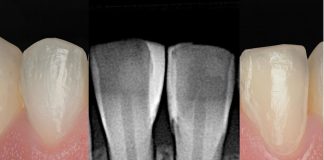
Radiographic evaluation before and after the restoration.

Fig.11
Results after 1 month of follow-up.
Conclusions
The dual availability of this material in two distinct viscosities offers clinicians the opportunity to optimize the snowplow technique, an efficient method for accelerating the completion of direct restorations. In slot-shaped cavities, this approach serves as a practical and effective alternative, facilitating the achievement of a robust and precise marginal seal.
The snowplow technique involves the initial application of a low-viscosity flowable composite, which remains uncured while being displaced by a higher-viscosity restorative material during the layering process. When combined with bulk-fill composites of both viscosities, this technique enhances the procedure by simplifying material application, minimizing void formation, and improving adaptation to cavity walls. Moreover, the use of modern bulk-fill composites allows for improved aesthetic results, with excellent optical properties and a chameleon effect that ensures seamless blending with the surrounding tooth structure. Clinically, the snowplow technique not only reduces procedural time but also ensures a durable, reliable seal and an enhanced visual integration of the restoration, making it particularly advantageous in both posterior and anterior restorations.
Bibliography
- Putignano A, Tosco V, Monterubbianesi R, Vitiello F, Gatto ML, Furlani M, Giuliani A, Orsini G. Comparison of three different bulk-filling techniques for restoring class II cavities: μCT, SEM-EDS combined analyses for margins and internal fit assessments. J Mech Behav Biomed Mater. 2021 Dec;124:104812. doi: 10.1016/j.jmbbm.2021.104812. Epub 2021 Sep 3. PMID: 34500356.
- Ölçer Us Y, Aydınoğlu A, Erşahan Ş, Erdem Hepşenoğlu Y, Sağır K, Üşümez A. A comparison of the effects of incremental and snowplow techniques on the mechanical properties of composite restorations. Aust Dent J. 2024 Mar;69(1):40-48. doi: 10.1111/adj.12982. Epub 2023 Oct 9. PMID: 37814190.
- Rosatto CM, Bicalho AA, Veríssimo C, Bragança GF, Rodrigues MP, Tantbirojn D, Versluis A, Soares CJ. Mechanical properties, shrinkage stress, cuspal strain and fracture resistance of molars restored with bulk-fill composites and incremental filling technique. J Dent. 2015 Dec;43(12):1519-28. doi: 10.1016/j.jdent.2015.09.007. Epub 2015 Oct 9. PMID: 26449641.