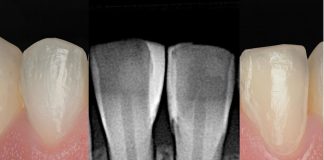
Smile makeovers with direct composite restorations have become more reliable in recent years due to advancements in adhesive and composite systems, along with simplified tools and techniques that make daily work repeatable and predictable. One of the key factors is selecting the proper matrix system, which helps predict and visualize the final shape of the restorations. This article demonstrates how to use the new Unica Proximal matrix for smile enhancement in a very simple and fast way.


Fig.1
This 23-year-old female patient was dissatisfied with her smile due to multiple defective composite restorations, causing discoloration between the teeth. After discussing treatment options, she opted for a cost-effective solution with direct composite resin as a minimally invasive approach to enhance her smile.

Fig.2
The retracted view reveals multiple defective Class III restorations between teeth 13-23, contributing to yellowish and brown discoloration.

Fig.3
The side view shows an old defective composite restoration between teeth 21-22, which needs to be replaced.

Fig.4
The side view reveals defective class III restorations between teeth 11-12, and tooth 11 has been treated with root canal treatment (RCT).

Fig.5
The black contrast view highlights the shape disharmony between the right and left sides. The goal of this treatment is to replace the old, defective composite restorations and improve both the color and shape of the 3-3 teeth through direct composite veneering.

Fig.6
Split rubber dam isolation is essential to ensure a clean, contaminant-free environment, providing optimal visibility during the procedure.

Fig.7
Split rubber dam isolation is essential to ensure a clean, contaminant-free environment, providing optimal visibility during the procedure.

Fig.8
Enamel was etched using phosphoric acid for 30 seconds.

Fig.9
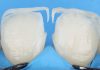
In the context of direct veneering to enhance both shape symmetry and color homogeneity, the Unica Proximal matrix was utilized on multiple teeth simultaneously to construct the Unica frame.
What is Unica Proximal?
Unica Proximal matrices are specifically designed for anterior restorations that involve the proximal walls, including Class III and IV restorations, peg-shaped lateral incisors, diastema closures, and both partial and total veneers. The cervical labiopalatal arch is easy to place and secures the matrix subgingivally between the papilla and the tooth, enhancing matrix stability after placement. While a wedge can be used to further secure the matrix, it is not essential. The matrix is uniquely shaped to ensure an optimal fit on anterior teeth, providing improved visibility and access to the operative field compared to traditional posterior sectional matrices.

Fig.10
The proximal walls were constructed using a universal dentin shade that matched the shade selected for the direct veneering, ensuring a seamless integration and natural appearance in the final restoration.

Fig.11
Simplified layering techniques were employed for the restoration of teeth 13-23, utilizing a universal dentin shade for both the veneering material and proximal walls. To enhance aesthetics, only the incisal one-third was characterized with enamel, creating a more natural appearance while streamlining the process. This approach proved to be easy and efficient, avoiding the need for a single dentin shade throughout the restoration.

Fig.12
Simplified Finishing and Polishing:
Contouring: One disc is used to contour the outer shape of the restoration.
Surface Texture: One bur is employed to create the necessary surface texture.
Pre-Polishing: One rubber twist shape is utilized for pre-polishing, initiating the surface preparation for the final polishing step.
Final Polishing: The process concludes with one final polishing step using Lucida polishing for a smooth, high-gloss finish.

Fig.13
The Lucida™ Star and Diashine Lucida™ Paste facilitate a single-step high-gloss polishing process for composite restorations, ensuring an efficient and effective finish.

Fig.14
Immediately after the final polishing.

Fig.15
Retracted view taken during the two-week follow-up shows significant improvement in the aesthetic outcome.

Fig.16
The side view of the final situation illustrates the successful restoration of the anterior teeth.

Fig.17
The side view of the final situation.

Fig.18
Black contrast- with harmony between the right and left side.

Fig.19
The patient’s final smile reflects the successful transformation achieved through the direct composite restorations.
Conclusions
A composite smile makeover is not only an affordable and minimally invasive option but also a reliable choice for patients, thanks to recent advancements in techniques and tools that enhance the predictability and repeatability of the procedures. These innovations ensure that dentists can deliver high-quality results consistently, improving both patient outcomes and satisfaction.
Bibliography
- Devoto W, Saracinelli M, Manauta J. Composite in everyday practice: how to choose the right material and simplify application techniques in the anterior teeth.
- Manauta J, Salat A. Layers, An atlas of composite resin stratification., Quintessence Books, 2012.
- Blitz N. Criteria for success in creating beautiful smiles. Oral Health 1997; 87: 38–42.
- Villarroel M, Fahl N, De Sousa AM, De Oliveira OB Jr. Direct esthetic restorations based on translucency and opacity of composite resins. J Esthet Restor Dent 2011;23(2):73-87.
- Morley J, Eubank J. Macroesthetic elements of smile design. J Am Dent Assoc 2001; 132: 39-45.
- Blitz N. Criteria for success in creating beautiful smiles. Oral Health 1997; 87: 38–42.
- Manauta J, Salat A, Putignano A, Devoto W, Paolone G, Hardan LS. Stratification in anterior teeth using one dentine shade and a predefined thickness of enamel: A new concept in composite layering – Part II. Odontostomatol Trop 2014; 37 (47): 5-13.