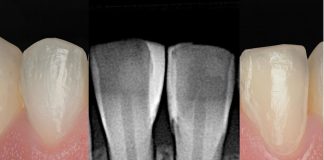
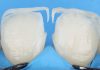
A clinical case by our Community member Dr. Prjeen Bazeed
This article and its content are published under the Author’s responsibility as an expression of the Author’s own ideas and practice. Styleitaliano denies any responsibility about the visual and written content of this work.
Anterior diastemas represent a common aesthetic concern in everyday clinical practice and frequently require an approach that balances simplicity, control, and conservation of tooth structure. Direct composite restorations offer a highly versatile solution for anterior diastema closure, enabling clinicians to modify tooth form, proportions, and symmetry while sticking to a minimally invasive workflow. In selected cases, the use of a monoshade composite can simplify the restorative protocol while still achieving harmonious optical integration within the smile.

Fig.1
A female patient presented with concerns regarding the appearance of her smile. The initial frontal view revealed anterior spacing and irregular tooth proportions, compromising smile harmony with the result of an aesthetic imbalance.

Fig.2
A retracted intraoral view captured against a black background highlights the anterior spacing, tooth proportions, and surface characteristics. This contrast facilitates detailed evaluation of dental shape, symmetry, and esthetic discrepancies.

Fig.3
Rubber dam isolation secured with floss ligatures provided effective moisture control and gingival retraction, ensuring optimal visualization of the operative field prior to initiating the restorative procedures.

Fig.4
Following surface refinement, the enamel surfaces were conditioned through air abrasion and etched with 37% phosphoric acid to properly prepare the substrate for adhesive application.

Fig.5
The palatal shell was constructed using a body shade composite (OA1), assisted by a transparent matrix strip to establish the initial contour.

Fig.6
Final contour of the palatal shell defining the proximal and incisal morphology.

Fig.7
Body shade composite (OA1) was applied to complete proximal closure and recreate the labial surface contour, establishing the primary form of the restoration.

Fig.8
After rubber dam removal, anatomical reference markings were applied to guide surface refinement and harmonize tooth proportions, line angles, embrasures, and incisal edges.

Fig.9
Final frontal smile view after finishing and polishing, showing harmonized proportions, controlled surface anatomy, and a natural light reflection achieved with a monoshade composite approach.

Fig.10
Final intraoral frontal view of the definitive composite restoration.

Fig.11
Extraoral view of the final outcome before and after treatment.
Conclusions
This clinical case demonstrates that anterior aesthetic challenges can be successfully managed with direct composite restorations using a conservative and controlled approach. Careful attention to tooth morphology, surface texture, and optical integration allowed the restorations to blend naturally with the surrounding dentition. The use of a mono-shade composite approach proved effective when guided by proper anatomical design and precise finishing and polishing. Within the limitations of a single clinical report, direct composite restorations remain a versatile and minimally invasive option for predictable aesthetic enhancement when planning and execution are carefully respected.
Bibliography
- Manauta J, Salat A. Layers: An Atlas of Composite Resin Stratification. Quintessence Publishing; 2012.
- Fahl N Jr. Direct composite bonding in anterior dentistry: indications and simplified clinical approaches. Quintessence Publishing; 2015.
- Devoto W, Saracinelli M, Manauta J. Composite in everyday practice: how to choose the right material and simplify application techniques in the anterior teeth. European Journal of Esthetic Dentistry. 2010;5(1):102–124.