


In every general dental practice, the majority of cavities resulting from caries are proximal posterior lesions.
Clinicians are constantly seeking techniques that deliver functional and esthetic outcomes while minimizing post-operative sensitivity. Additionally, unfavorable tooth position or anatomy can further complicate treatment.
This case report demonstrates how the combination of the appropriate technique and modern materials can produce high-quality posterior restorations with excellent esthetics and function both quickly and efficiently. The material selection also highlights a predictable and streamlined workflow for these restorations.

Fig.1
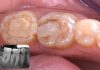
A 19-year-old patient presented with mild tooth sensitivity. Clinical and radiographic examination revealed a Class II lesion in tooth 16.

Fig.2
The cavity was prepared by removing defective enamel with diamond burs and infected dentine with a round carbide bur. This protocol is essential, as it produces a less complex smear layer, thereby improving bonding when using selective etching in combination with a one-step self-adhesive universal bonding agent.

Fig.3
Tooth 16 exhibited a rotated position, resulting in a large open embrasure on the palatal side.

Fig.4
A pronounced curvature on the mesial aspect of the molar presented an additional anatomical challenge.

Fig.5
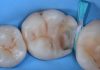
A flexible thin molar band (Flexmat; Polydentia) was used to establish the boundary of the mesial wall. A wooden wedge (KERR Dental) was inserted into the embrasure space, providing better tooth separation than flexible plastic wedges and ensuring improved contact with adjacent teeth.

Fig.6
A band retainer (Polydentia) was used, and its unique design allowed the matrix band to effectively brace the tooth. Conventional sectional matrix retainers may extend excessively into the embrasure, preventing the reproduction of the natural tooth curvature.

Fig.7
Teflon tape was inserted between the band and retainer to achieve a hermetic seal at the mesial finish line.

Fig.8
A selective etching technique was performed using 35% phosphoric acid (KERR Dental) applied to enamel for 30 seconds. This etchant is viscous and remains where applied, unlike conventional etchants that tend to flow.

Fig.9
A single coat of universal bonding agent (OptiBond Universal 360; KERR Dental) was applied and actively scrubbed for 30 seconds. This application technique, combined with the material’s chemistry, ensures high bond strength and minimizes post-operative sensitivity, thus also providing long term success of the restoration.


Fig.10
The bonding layer was stabilized with a very thin layer of flowable composite (SimpliShade Bulk Fill Flow; KERR Dental).

Fig.11
The proximal wall was constructed using a medium opacity universal composite (SimpliShade; KERR Dental) with the snow-plow technique.

Fig.12
Flowable bulk-fill composite (SimpliShade Bulk Fill Flow; KERR Dental) was used for dentine replacement, leaving approximately 1.5 mm for the enamel layer, confirmed with a Posterior Misura (LM Instruments).


Fig.13
The occlusal surface was restored using a universal bulk-fill composite (SimpliShade; KERR Dental) in a single increment with the Espresso Posterior Technique, with light brown characterization added in selected areas.

Fig.14
After polymerization of the final layer, liquid glycerine was applied.

Fig.15
The restoration was polymerized through the glycerine layer for 60 seconds, ensuring optimal curing and eliminating unpolymerized monomers on the surface.

Fig.16
Interproximal finishing was carried out using polishing discs (OptiDisc; KERR Dental) in progressively finer grits. Their flexible design prevents scratching, as the metal mandrel does not protrude beyond the disc surface.

Fig.17
A 40-micron articulating paper was used to identify high occlusal contacts.

Fig.18
Occlusal pressure points were adjusted using a red football-shaped diamond bur.

Fig.19
Final polishing was performed using a three-step protocol, starting with Opti1Step rubbers (KERR Dental).

Fig.20
Further polishing was carried out using OccluBrush (KERR Dental).

Fig.21
Final polishing was completed with a spiral wheel.

Fig.22
At one-week follow-up, the restoration showed seamless integration, excellent proximal contact, and no post-operative sensitivity.

Fig.23
One-week follow-up.
Conclusions
This workflow—combining selective etching, a high-performance universal bonding agent, bulk-fill flowable composite for dentine replacement, and universal composite for both proximal wall and enamel reconstruction using the Espresso Posterior Technique—results in a seamless Class II posterior restoration.
This approach is not only efficient and time-saving but also delivers predictable esthetic and functional outcomes. The bonding system used ensures excellent long-term bond strength while eliminating post-operative sensitivity.
Bibliography
- Hardan L, Sidawi L, Akhundov M, Bourgi R, Ghaleb M, Dabbagh S, Sokolowski K, Cuevas-Suárez CE, Lukomska-Szymanska M. One-year clinical performance of the fast-Modelling bulk technique and composite-up layering technique in class I cavities. Polymers. 2021 Jun 4;13(11):1873.
- Manauta J. Back to basics: bulk and body. 2016 www.styleitaliano.org
- Attar N. Influence of flowable composite lining on the microleakage and adaptation of composite restorations. Journal of Dentistry. 2016 Mar;44:14-20.
- Chiodera G, Monterubbianesi R, Tosco V, Papini O, Orsini G, Putignano A. Application of Bulk-Fill Composite to Simplify the Cementation of Indirect Restorations: The COMBO Technique. Dent J (Basel). 2024 Jul 29;12(8):239. doi: 10.3390/dj12080239. PMID: 39195083; PMCID: PMC11352567.
- Putignano A, Tosco V, Monterubbianesi R, Vitiello F, Gatto ML, Furlani M, Giuliani A, Orsini G. Comparison of three different bulk-filling techniques for restoring class II cavities: μCT, SEM-EDS combined analyses for margins and internal fit assessments. J Mech Behav Biomed Mater. 2021 Dec;124:104812. doi: 10.1016/j.jmbbm.2021.104812. Epub 2021 Sep 3. PMID: 34500356.