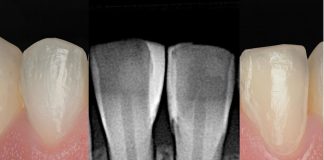
Management of anterior teeth presenting with pre-existing composite restorations that require replacement for aesthetic reasons can be challenging. Color mismatch, marginal defects, and aging restorations often compromise smile harmony and require a predictable restorative strategy.
In these situations, performing a tooth whitening treatment before replacing the restorations can be highly beneficial. Whitening not only improves the overall brightness of the dentition but also helps to establish a more favorable and uniform substrate, allowing clinicians to better predict the aesthetic outcome of the new restorations.
Once the desired shade has been achieved, replacing the existing restorations becomes more predictable, as the restorative materials can be selected and adapted to the newly established tooth color.
In this context, simplified composite systems such as Filtek™ Easy Match can facilitate the restorative procedure by simplifying shade selection while maintaining natural optical integration with the surrounding tooth structure.


Fig.1
Initial clinical situation showing aesthetic discrepancies caused by old composite restorations on the maxillary lateral incisor and contralateral canine.

Fig.2
Shade was evaluated after completion of the whitening treatment. A minimum waiting period of 15 days was respected to ensure optimal adhesive performance.

Fig.3
Shade evaluation performed using Filtek™ Easy Match Universal Restorative determined that the Bright shade would be used for the final restoration.


Fig.4
Rubber dam isolation prior to the restorative procedure.

Fig.5
Careful removal of the previous composite restoration using a diamond finishing bur.

Fig.6
Removal of residual restorative material with LM-Arte™ Dark Diamond Eccesso instrument and preparation of the tooth surface.

Fig.7
Placement of Unica Minideep Anterior matrix (Polydentia / StyleItaliano) to guide the reconstruction of the proximal and cervical contours.

Fig.8
Proper adaptation of the matrix is fundamental to define the emergence profile and proximal anatomy.

Fig.9
Application of phosphoric acid for selective enamel etching.

Fig.10
Unica Minideep Anterior matrices (Polydentia / StyleItaliano) were used to guide phosphoric acid placement, ensuring proper etching of the intended areas while protecting the adjacent teeth.

Fig.11
A universal adhesive system (Scotchbond Universal) was applied before composite placement.


Fig.12
Careful distribution of the adhesive on the prepared surfaces, on the lateral first.

Fig.13
And then on the canine.

Fig.14
Light curing of the adhesive layer to ensure proper polymerization.

Fig.15
To improve adaptation with the Unica MiniDeep matrix, Filtek™ Easy Match Flowable Restorative (Bright) was applied as an initial layer before placing Filtek™ Easy Match Universal Restorative to complete the restoration.


Fig.16
Initial placement of Filtek™ Easy Match Flowable Restorative material guided by the matrix.

Fig.17
Placement of Filtek™ Easy Match Universal Restorative composite in shade Bright to restore the tooth structure.

Fig.18
View after removal of the Unica MiniDeep matrix showing the newly formed proximal contour.

Fig.19
Modeling of the composite with LM-Arte™ Dark Diamond Modella instrument to reproduce natural tooth morphology.

Fig.20
Removal of the matrix in the canine revealing the newly restored proximal contours.

Fig.21
Preview of the result prior to making the final anatomy.

Fig.22
Refinement of the restoration anatomy before starting the finishing procedures.

Fig.23
Light curing of the composite restoration under glycerin gel.

Fig.24
Finishing and polishing procedures.

Fig.25
Final clinical result showing harmonious integration of the new restorations with the whitened dentition and natural anterior morphology.

Fig.26
Frontal view in occlusion showing harmonious aesthetic integration of the restorations while confirming proper functional relationships.

Fig.27
Final intraoral result demonstrating good anatomical integration with the adjacent teeth.
Conclusions
Filtek™ Easy Match Universal Restorative simplifies the restorative workflow through intuitive shade selection and naturally adaptive opacity. The simplified shade concept allows clinicians to efficiently match restorations to whitened dentition while maintaining excellent handling properties and natural optical integration.
This approach facilitates predictable aesthetic rehabilitation of anterior teeth after whitening procedures.
Bibliography
- Alqahtani MQ. Tooth-bleaching procedures and their controversial effects: A literature review. Saudi Dent J. 2014 Apr;26(2):33-46. doi: 10.1016/j.sdentj.2014.02.002. Epub 2014 Mar 12. PMID: 25408594; PMCID: PMC4229680.
- Nurrohman H, Korkmaz-Ceyhan Y, Cevik P, Paravina RD. Staining- and aging-dependent changes in color, translucency, and gloss of cloud-shade and one-shade resin composites. Am J Dent. 2024 Aug;37(4):201-205. PMID: 39186601.
- Altınışık H, Özyurt E. Effect of different polishing systems on surface roughness and gloss values of single-shade resin composites. BMC Oral Health. 2024 Nov 15;24(1):1391. doi: 10.1186/s12903-024-05163-z. PMID: 39548450; PMCID: PMC11568551.