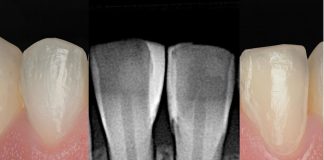
Non-carious cervical lesions (NCCLs) restorations often pose a challenge due to the limited enamel surface, the presence of sclerotic dentin, and the need for high aesthetic integration in areas exposed to both function and visibility. Achieving a durable bond, optimal marginal adaptation, and seamless aesthetic integration is essential for the long-term success of Class V restorations. In such cases, the choice of a versatile and easy-to-use material can greatly simplify the procedure while ensuring long-lasting results.
This clinical case highlights a streamlined and effective approach using Easy Match, a smart universal composite specifically designed to simplify shade selection and blending with natural dentition. Thanks to its chameleon-like optical properties and ideal handling characteristics, Easy Match allows for efficient, predictable, and highly aesthetic Class V restorations with minimal chair time.


Fig.1
Rubber dam isolation is essential to achieve optimal long-term results. The use of a clamp can help isolate the entire lesion effectively while providing gingival retraction, ensuring a clean and dry working field.

Fig.2
The use of matrices supports accurate reconstruction of the cervical margin. Wooden wedges help adapt the matrix tightly against the cavity walls, minimizing the risk of excess material while also preventing voids in the restoration.

Fig.3
Selective air abrasion was performed using the AquaCare system with 29 μm aluminum oxide particles. This technique effectively cleans the dentin surface, and increases micromechanical retention, thereby enhancing adhesive penetration and improving the overall bonding strength of the restoration.

Fig.4
Selective enamel etching was performed using 37% phosphoric acid for 20 seconds.

Fig.5
Scotchbond Universal adhesive was actively applied using a microbrush, following a scrubbing technique to promote effective infiltration into the etched enamel and dentin surfaces.


Fig.6
After adhesive application, a thin layer of Filtek Supreme Flowable composite was placed to seal and regularize the dentin surface. This step enhances the adaptation of the final restorative material and contributes to long-term bond durability.


Fig.7
The material was shaped with the LM Fissura instrument.

Fig.8
Afterwards, the Class V lesion was restored using the Warm shade of Easy Match composite. Thanks to its advanced optical properties and optimized mechanical strength, the material allows for single-shade application with excellent aesthetic integration and reliable single-increment placement, making it suitable for stress-bearing cervical areas.


Fig.9
Aspect of the final restoration before polishing, which will be completed after restoring the lateral incisor.

Fig.10
After completing the restoration on the central incisor, the clamp was repositioned on the lateral incisor to proceed with the same restorative protocol.

Fig.11
Selective enamel etching was performed on the lateral incisor using 37% phosphoric acid.

Fig.12
Typical chalky appearance of etched enamel after selective phosphoric acid etching, indicating effective surface preparation for optimal adhesive performance.

Fig.13
After application of Scotchbond Universal, the cervical lesion was restored using only Filtek Supreme Flow. This nanofilled flowable composite offers an ideal combination of adaptability, wear resistance, and optical blending, making it suitable for minimally invasive restorations. The material was shaped with the LM Fissura instrument to accurately reproduce the natural cervical contour of the tooth.

Fig.14
Polishing was performed using Spiral Wheels under water irrigation provided by a syringe. This technique helps reduce heat generation and enhances the surface gloss of the restoration while preserving the integrity of the surrounding tissues.


Fig.15
Final appearance of the two restorations following removal of the rubber dam, showing good integration and surface finish. A complete aesthetic evaluation will be performed after tooth rehydration, which is essential to assess the final shade match and translucency.

Fig.16
At the one‑month follow‑up, the restoration shows excellent aesthetic integration with the surrounding tooth structure. The gingival tissues appear healthy and free of inflammation, reflecting the cleanability of both the restorations and the cervical area—thanks to the smooth, highly polished surfaces that minimize plaque accumulation.
Conclusions
Class V restorations have always posed a clinical challenge due to the anatomical complexity of the cervical region, limited enamel adhesion, and the need for both aesthetic and functional reliability. Today, the availability of advanced materials—such as Easy Match, with its excellent shade-matching capabilities, and nanofilled flowable composites like Filtek Supreme Flow—offers clinicians reliable solutions that simplify these procedures.
As shown in this case, when the restorative strategy is supported by a proper understanding of both the technique and the material’s properties, even challenging Class V lesions can be successfully managed in a single session using a single-shade, single-material approach, ensuring long-term performance and aesthetic integration.
Bibliography
- Oz, F.D., Kutuk, Z.B., Ozturk, C. et al. An 18-month clinical evaluation of three different universal adhesives used with a universal flowable composite resin in the restoration of non-carious cervical lesions. Clin Oral Invest 23, 1443–1452 (2019). https://doi.org/10.1007/s00784-018-2571-2.
- Goodacre CJ, Eugene Roberts W, Munoz CA. Noncarious cervical lesions: Morphology and progression, prevalence, etiology, pathophysiology, and clinical guidelines for restoration. J Prosthodont. 2023;32:e1–e18. https://doi.org/10.1111/jopr.13585.
- Rosatto CM, Bicalho AA, Veríssimo C, Bragança GF, Rodrigues MP, Tantbirojn D, Versluis A, Soares CJ. Mechanical properties, shrinkage stress, cuspal strain and fracture resistance of molars restored with bulk-fill composites and incremental filling technique. J Dent. 2015 Dec;43(12):1519-28. doi: 10.1016/j.jdent.2015.09.007. Epub 2015 Oct 9. PMID: 26449641.