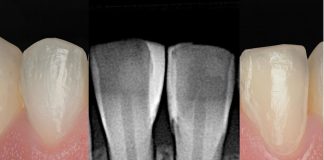
A clinical case by our Community member Dr Nasim Akhatov
This article and its content are published under the Author’s responsibility as an expression of the Author’s own ideas and practice. Styleitaliano denies any responsibility about the visual and written content of this work.
Maintaining a healthy, beautiful smile and proper chewing ability is important for everyone. Damaged teeth can cause significant issues, making people self-conscious about speaking and smiling, and making chewing difficult.
To address these problems, dentists use a variety of modern techniques, innovative technologies, and advanced methods for prevention, diagnosis, treatment, and restoration of teeth.
Today, direct and indirect restorations are widely used to restore the anatomical shape of damaged teeth.
But what are these methods, and how do they differ?
This clinical case demonstrates how to restore the chewing function of teeth using the direct method with composite materials and the indirect method with ceramics.

Fig.1
The initial situation of teeth 46 and 47.

Fig.2
Tooth 46 has an incomplete restoration with an abnormal marginal fit. The old filling is almost half of the tooth crown.

Fig.3
After removing the old filling, it was decided to restore the 46th tooth with an indirect restoration because the destruction of the tooth exceeded 2/3 of the crown. Ceramic onlays were chosen to fully recreate the anatomical shape and restore the functional rigidity of the tooth.

Fig.4
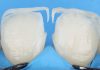
On the preparation day at the dental laboratory, working models and overlays in the form of onlays were fabricated using lithium disilicate.

Fig.5
Step-by-step onlay adhesive preparation before fixation.

Fig.6
The adhesive preparation of the 46 tooth begins with a 29-micron aluminum oxide sandblasting with the AQUACARE apparatus.

Fig.7
Tooth 45 was isolated using Teflon and the onlay was secured with composite cement.

Fig.8
Final curing of the cement with the lamp Curing Pen by Eighteeth (Changzhou, China).


Fig.9
After complete cement curing, the excess composite is removed with a scalpel No 12.

Fig.10
Using the polymer and silicone cups, polish the onlay to a glossy surface with polishing paste and brush.

Fig.11
Final situation of the tooth 46.

Fig.12
Next, the restoration of tooth 47 will proceed with direct composite material.

Fig.13
Step-by-step adhesive preparation of tooth 47.

Fig.14
The final condition of tooth 47 before removing the isolation system.

Fig.15
Photo after dental dam removal and occlusal check.
Conclusions
Recently, a variety of dental restoration methods, differing in technology, have become highly relevant in dentistry. The choice of methods for restoring the chewing surfaces of teeth depends on the situation and the volume of natural tissue available. However, the primary goal of a dentist is to achieve a successful and long-lasting result.
Bibliography
- Koubi S. Bringing up deep proximal margins. Simplifying everyday dentistry. 2022. Styleitaliano.org.
- Ferraris F. Posterior indirect adhesive restorations (PIAR): preparation designs and adhesthetics clinical protocol; the international journal of esthetic dentistry. 2017
- Marchetti G. Clinic meets research Vol.3. 2014. Styleitaliano.org.