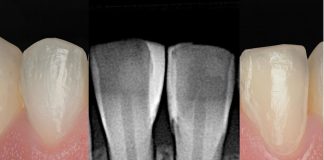
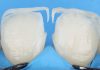
In deep cavities characterized by a thin pulpal roof and cold-induced sensitivity, the adjunctive use of tricalcium silicate–based materials, such as Biodentine XP, proved effective in eliminating postoperative sensitivity while preserving pulp vitality. When an accurate diagnosis is established, contemporary vital pulp therapy becomes increasingly predictable and clinically manageable, particularly when the biological and mechanical properties of modern materials are well understood. This article demonstrates how a deep carious lesions can be efficiently restored in a single session using simplified, biologically driven restorative approaches.

Fig.1
Once the proper occlusion was verified on the previous restorations, the infiltrated composite restoration on the second molar—reported by the patient as sensitive to cold—was removed. Given the presence of a very deep cavity and the need for pulp capping, the tooth was subsequently isolated individually after completion of the restorations to improve isolation control and minimize the risk of contamination.

Fig.2
Aspect of the prepared cavity, characterized by a very deep extension with hard, firm dentin and a thin residual dentinal layer. For this reason, an indirect pulp capping procedure with Biodentine™ XP was performed to protect and stimulate the pulp, preserve tooth vitality, and eliminate cold sensitivity.

Fig.3
Biodentine™ XP application performed using a bio–bulk-fill technique. The material was initially adapted with an LM-Condensa instrument and subsequently refined and gently leveled using a brush, leaving adequate space for the subsequent placement of the composite layer.


Fig.4
Immediately after placement, without waiting for complete setting of the material, a self-adhesive flowable composite (Vertise™ Flow, Kerr) was applied to protect Biodentine™ XP by sealing the cavity and allowing subsequent adhesive procedures to be performed without damaging the pulp-capping material. After polymerization, the cavity was redefined using rotary instruments, creating enamel bevels at the margins and reducing the thickness of the self-adhesive flowable layer.

Fig.5
Subsequently, adhesive procedures were performed as if no previous material had been applied, following the same protocol used for untreated cavities. A next-generation universal adhesive system (OptiBond™ 360, Kerr) was applied with active scrubbing in two consecutive applications, followed by 20 s of gentle air-drying and light-curing.

Fig.6
The cavity was subsequently completed by filling it with the bulk-fill composite (SimpliShade Bulk-Fill, Kerr) used for the previous restorations. The material was adapted and excess was removed, preparing the surface for the design of the Espresso Posterior Technique

Fig.7
Occlusal lines were created using the LM-Replica Posterior instrument, designed to reproduce the occlusal morphology through simple and controlled movements.

Fig.8
Final clinical outcome following rubber dam removal and occlusal contact assessment.

Fig.9
One-month follow-up demonstrating absence of postoperative sensitivity and stable direct restorations, maintaining proper function and favorable aesthetic integration.

Fig.10
Radiographs at the 1-month follow-up showing maintained pulp vitality, absence of secondary caries or restorative deterioration, and the presence of Biodentine™ XP protecting the pulp in the second molar.
Conclusions
Biodentine™ XP represents a reliable dentine substitute owing to its biocompatibility, sealing ability, and favorable mechanical properties. In the present clinical case, its application within a bio–bulk-fill approach enabled direct pulp capping and definitive restoration in a single session, thereby reducing the risk of secondary contamination and postoperative infiltration. The superficial coverage with a self-adhesive flowable composite allowed refinement of cavity margins and facilitated subsequent adhesive and restorative procedures without compromising the underlying calcium silicate–based material.
The use of next-generation universal adhesive systems further contributed to the clinical predictability of the procedure, providing a strong and stable bond to different substrates, as highlighted in this case. Additionally, modern bulk-fill composite resins enabled efficient cavity filling with reduced risk of air entrapment and void formation, while ensuring satisfactory aesthetic integration.
The combined use of Biodentine XP and bulk-fill composite resin, shaped according to the Espresso Posterior technique, resulted in a predictable, functional, and aesthetic outcome.
Bibliography
- Manauta J, Salat A, Devoto W, Putignano A. Layers 2. Direct composite: the StyleItaliano clinical secrets. 2022. Quintessence pub.
- Chiodera G. Lines: una guida per eseguire restauri posteriori diretti semplici e di successo. Quintessenza Edizioni; 2022.
- Mishra A, Natanasabapathy V, Suresh N. The influence of sodium hypochlorite concentration on the fibrin structure of human blood clots and transforming growth factor-beta 1 release: an ex vivo study. Restor Dent Endod. 2022 Oct 31;47(4):e42. doi: 10.5395/rde.2022.47.e42. PMID: 36518611; PMCID: PMC9715373.
- Alfaisal, Y., Idris, G., Peters, O.A., Zafar, S., Nagendrababu, V. & Peters, C.I. (2024) Vital pulp therapy—Factors influencing decision-making for permanent mature teeth with irreversible pulpitis: A systematic review. International Endodontic Journal, 57, 505–519.
- Ricucci D, Siqueira JF Jr, Li Y, Tay FR. Vital pulp therapy: histopathology and histobacteriology-based guidelines to treat teeth with deep caries and pulp exposure. J Dent. 2019 Jul;86:41-52. doi: 10.1016/j.jdent.2019.05.022. Epub 2019 May 21. PMID: 31121241.