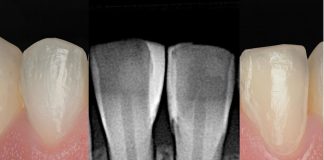
Clinical case written in cooperation with Dr. Paulo Monteiro
Bulk Fill resin composites, such as Filtek™ One (Solventum), have gained significant attention in restorative dentistry, particularly for direct posterior restorations. These materials are designed to streamline the restoration process by allowing placement in thicker layers, reducing the need for incremental layering while maintaining adequate polymerization. Filtek™ One (Solventum), a prominent Bulk Fill composite, is engineered to offer enhanced depth of cure, low polymerization shrinkage, and improved mechanical properties, making it a favorable option for restoring posterior teeth. This article reviews the clinical application of Filtek™ One Bulk Fill resin (Solventum) in posterior direct restorations, focusing on its benefits, limitations, and clinical outcomes.



Fig.1
Initial situation. Adult patient with old amalgam restorations and secondary caries in the lower molars.

Fig.2
Close-up view of the the initial situation.

Fig.3
After removal of the old amalgam restorations.

Fig.4
After removing the secondary caries and thoroughly cleaning the cavity, the composite restoration was performed, beginning with the second molar. Filtek™ One Bulk Fill composite resin (Solventum) was used for the restoration.


Fig.5
To restore the complex MOD cavity, the QuickmatFLEX posterior sectional matrices from Polydentia were used, along with the myRing Forte matrix system from Polydentia.

Fig.6
After applying the adhesive system, the complex Class II cavity was converted into a Class I by building up the proximal walls using the Filtek™ One Bulk Fill composite resin (Solventum).

Fig.7
Using the LM Solo Posterior instrument, we can accurately measure the depth of the cavity, ensuring the correct amount of composite resin material is placed.

Fig.8
In this case, since the cavity depth was less than 5 mm, we were able to use a single increment of Filtek™ One Bulk Fill (Solventum).

Fig.9
The composite resin was compacted into the cavity using the Solo Posterior instrument, ensuring good adaptation to the surrounding tooth margins to create a smooth, seamless transition.

Fig.10
Using the sharp tip of the Solo Posterior instrument, the occlusal anatomy was shaped following the Essential Lines concept by StyleItaliano.

Fig.11
After modeling the occlusal surface of the restoration, the composite was light-cured for 20 seconds per surface. As you can see this Bulk Fill composite offers excellent handling, allowing the anatomy to remain intact without any flow or deformation.

Fig.12
The natural anatomy of the direct composite restoration is evident, along with the seamless shade and opacity integration of the Filtek™ One composite (Solventum) with the surrounding tooth structure.

Fig.13
Final clinical situation after hydration. The integration and natural appearance of the composite restorations are clearly visible.
Conclusions
In conclusion, the use of Bulk Fill resins, such as Filtek™ One (Solventum), in posterior direct restorations offers a practical and efficient solution for clinicians. Its capacity for placement in thicker increments without compromising polymerization or mechanical properties simplifies the restorative process, thereby reducing chair time while ensuring high clinical performance. The material’s favorable characteristics, including reduced polymerization shrinkage, enhanced depth of cure, and improved mechanical strength, make it a reliable choice for posterior restorations. Although further long-term studies are necessary to confirm its durability, current evidence supports its efficacy and advantages in everyday clinical practice.
Bibliography
- Ilie N, Hickel R. Resin composite restorative materials in the light of durability and clinical performance investigations. Dent Mater. 2011 Jan;27(1):29-43.
- Garoushi S, Säilynoja E, Vallittu P, Lassila L. Characterization of a new fiber-reinforced bulk fill composite. Dent Mater J. 2013 Oct;32(5):835-41.
- Czasch P, Ilie N. In vitro comparison of mechanical properties and degree of cure of bulk fill composites. Clin Oral Investig. 2013 Feb;17(1):227-35.
- Alrahlah A, Silikas N, Watts DC. Post-cure depth of cure of bulk fill dental resin-composites. Dent Mater. 2014 Feb;30(2):149-54.
- Van Ende A, De Munck J, Lise DP, Van Meerbeek B. Bulk-fill composites: a review of the current literature. J Adhes Dent. 2016 Dec;18(6):537-58.