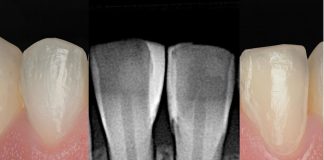
A bright, confident smile can significantly enhance our patients’ well-being and overall appearance. With advancements in dental care, achieving a beautiful smile has become more accessible than ever. One such approach combines the simplicity of home bleaching using carbamide peroxide with the precision of direct composite restoration. This innovative method not only enhances the aesthetics of the teeth but also ensures the preservation of dental structure. Additionally, the use of colorimeters highlights the progress of the treatment to achieve the final goal.
In this article, we will explore the step-by-step process of the home bleaching technique, emphasizing its benefits and effectiveness in achieving a beautiful, radiant smile.

Fig.1
The patient visited our clinic to address his aesthetic concern of general teeth discoloration and an old restoration on his central tooth. He requested a minimally invasive treatment with a cosmetically pleasing final outcome.
We proposed a home bleaching treatment, followed by replacing the composite on his tooth number 21. This treatment planning was approved by the patient.

Fig.2
The dark old composite should be replaced after bleaching of the whole teeth.

Fig.3
The closest match of the patient’s teeth were like 13 (2M2) color using Optishade colorimeter.

Fig.4
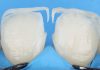
Custom-made splints or trays were created to fit the patient’s teeth. These trays are then used to hold the bleaching material, and the patient has been instructed on how to use them effectively.

Fig.5
10% Peroxide Carbamide gel (White Dental Beauty, UK) was used over night for 1 month.


Fig.6
After one month of night bleaching treatment, the color of the teeth improved significantly, going from 13 (2M2) to 3 (0.5M1).
The measurements were obtained using the Optishade Coloromiter (SmileLine, Switzerland)

Fig.7
The final tooth color exhibited a significant deviation from the initial shade.

Fig.8
The final tooth color is almost 1 M1 with a big satisfaction of the patient.
The 21 was restored with composite (Micerium, Italy) using the shades UD2+ UE3+ OBN (performed by Dr Jordi Manauta)

Fig.9
Here you can see the before and after result. A big obvious difference that pleased the patient.
Conclusions
In conclusion, modern dental approaches prioritize aesthetic treatment with minimally invasive techniques.
Bleaching followed by direct composite restorations provides excellent results without compromising dental integrity or healthy dental tissue.
If discoloration recurs over time, a short period of home bleaching can be undertaken to restore the desired outcome.
Bibliography
- Sara Laface. When a tray solves it all: How to treat dyschromia with not-invasive dentistry. Styleitaliano.org
- Sara Laface. When a tray solves it all (part 2): The two-step bleaching protocol. Styleitaliano.org
- Rim Bourgi. Evolution of dental bleaching, from research to clinical evidence. Styleitaliano.org