Achieving esthetic harmony in anterior restorations demands more than precision, it requires biological respect. Biologically Oriented Vertical Preparation offers a modern approach that eliminates traditional finish lines, allowing the restoration to follow the natural gingival contour. This technique promotes soft tissue stability, enhances emergence profiles, and supports long-term esthetic outcomes, making it a valuable tool in contemporary restorative dentistry.
All the pictures in this article were taken using a smartphone and SmileLite, the lighting system that you can attach to any phone (SmileLine, Switzerland, powered by Styleitaliano).


Fig.1
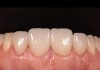
A 35 year old patient presented to our clinic seeking replacement of her existing crowns due to esthetic concerns.

Fig.2
Following the removal of the old crowns, the underlying teeth required structural reinforcement prior to the redo of the crowns. A decision was made to restore them using composite resin to ensure optimal foundation and esthetic integration.

Fig.3
All teeth were restored using composite resins and prepared according to the vertical preparation concept. Provisional restorations were then fabricated to guide soft tissue adaptation and esthetic contouring.

Fig.4
An occlusal view reveals the precision of the preparation and the healing of the surrounding gingival tissues, observed three weeks after the initial procedure.

Fig.5
From alternative angles, the healing of the gingival tissues is clearly evident. This highlights the strength of the vertical preparation technique, not only in minimizing unnecessary loss of dental structure, but also in promoting soft tissue harmony and healing through the use of well-adapted provisional restorations.

Fig.6
Zirconia crowns (Aidite, China) were fabricated to enhance the esthetics and contour of the patient’s smile, ensuring both natural appearance and long-term durability.

Fig.7
The zirconia crowns were tried in to evaluate their fit and confirm the desired anatomical contours.
Video.1
This video, captured using a smartphone mounted on the SmileLite MDP2 (Smileline, Switzerland), demonstrates the precise and effortless fit of the zirconia crowns on the maxillary central incisors.

Fig.8
Maxcem Elite Chroma (Kerr, California, USA) was used for crown cementation. This unique material features a color indicator that visually signals the optimal cleanup time, the pink hue gradually fades as it reaches the gel phase, guiding clinicians to remove excess cement at the ideal time. The Clean-up is remarkably easy to remove cement interproximally.

Fig.9
When Maxcem Elite Chroma reaches the white color, it is time to remove the excess. The cleanup is remarkably easy to remove the cement interproximally.

Fig.10
A close-up view highlights the seamless integration of the crowns with the surrounding healthy gingival tissue.

Fig.11
The before and after comparison reveals a big enhancement in esthetics. The new crowns exhibit a remarkably natural appearance and integrate harmoniously with the surrounding healthy gingival tissue.

Fig.12
The smile revealed a remarkably natural appearance of the new zirconia crowns, which the patient deeply appreciated.

Fig.13
The final picture was taken 6 months after treatment.
Conclusions
Biologically Oriented Vertical Preparation for anterior restorations represents a paradigm shift in esthetic and periodontal harmony.
When paired with high-performance zirconia crowns and a biological dual-cure cement, this approach ensures optimal marginal adaptation, soft tissue preservation, and long-term stability.
The vertical preparation technique facilitates a seamless emergence profile, while the cement’s visual cue system enhances clinical efficiency during excess removal.
Together, these elements contribute to a minimally invasive, biologically respectful workflow that delivers superior esthetic outcomes and patient satisfaction.
Bibliography
- Ashour, A.M., El-Kateb, M.M. & Azer, A.S. The effect of two preparation designs on the fracture resistance and marginal adaptation of two types of ceramic crowns using CAD/CAM technology (In vitro study). BMC Oral Health 24, 1065 (2024).
- Harsimran Kaur, Shivam Singhtomar and Pankaj Dhawan. Vertical Preparation: Biologically Oriented Preparation Technique (BOPT). Journal of Pierre Fauchard Academy (India Section), Vol 36(1), DOI: 10.18311/jpfa/2022/28626, March 2022.
- Blanca Serra-Pastor, Naia Bustamante-Hernández,Antonio Fons-Font, María Fernanda Solá-Ruíz, María Fernanda Solá-Ruíz. Periodontal Behavior and Patient Satisfaction of Anterior Teeth Restored with Single Zirconia Crowns Using a Biologically Oriented Preparation Technique: A 6-Year Prospective Clinical Study. J. Clin. Med. 2021, 10(16).