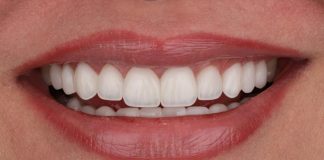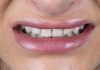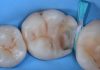



A 13-year-old male student came to my clinic with a brownish discoloration on his upper left canine. He had no systemic diseases and had not taken any drugs in the past. Since he was concerned about the poor aesthetics and needed orthodontic treatment that required braces on his upper teeth, and he had no contraindications for dental treatment, I decided to test a new material to treat his hypoplasia.

Fig.1
I applied the rubber dam as usual before excavation to retract the soft tissues and create a more comfortable working space.

Fig.2
Total etch was a necessary choice due to the difficulty of distinguishing enamel from dentin when applying orthophosphoric acid. A bevel on the vestibular side is often done on anteriors because it is easier to hide during finishing procedures, guarantees thickness to the composite, and ensures a smooth blend between the tooth and composite. However, in this specific case, a bevel would increase invasiveness, so I decided not to create any finishing lines. When performing direct composite restoration without any finishing lines, I extend the etching beyond the area to be reconstructed to make the transition between the natural tooth and composite as seamless as possible.

Fig.3
After etching both enamel and dentin, a universal adhesive was my first choice since it was suitable for all etching strategies. It was applied using a single-use dental brush called CompoBrush. Its thin and flexible bristles are ideal for spreading the bonding agent along the tooth’s surface, particularly in the proximal areas.

Fig.4
A flowable composite was used as the first layer. A flowable, one-shade, bulk-filling material with excellent color adaptation and low shrinkage stress. Using a sharpened instrument (FISSURA Dark Diamond Edition – LM arte), the flowable composite was uniformly spread on the exposed dentin.

Fig.5
A new simplified shade system for monochromatic restorations was used to finalize the case. In this specific case, the perfect match was achieved using the MEDIUM shade. SOLO Anterior is the most suitable tool for applying a single layer because it is ergonomic and allows the clinician to obtain a nearly perfect anatomy on anteriors. Sculptable composites should be preferred in combination with SOLO Anterior because they maintain their shape once modeled. This allows for the application of a single layer, with a maximum thickness of 2 millimeters. Simplifying the procedure minimizes the risk of failure.

Fig.6
Only a few small corrections were needed, as anteriors are always performed in a subtractive manner. StyleItaliano’s finishing protocol works very well by reducing the steps.

Fig.7
First of all, the primary anatomy has to be recreated. An abrasive disc can be very useful to highlight the transition lines, within which lies the “optic perception” of the restoration. Beyond the transition lines, the composite changes its angulation as we manage the optical width of the restoration by getting these lines closer or farther apart. In a young patient, secondary and tertiary anatomy are really important too. A perio-bur is particularly suitable for creating both.

Fig.8
Polishing was carried out with a two-step polishing system consisting of pre- and high-gloss rubbers at 7,500 rpm (optimum rotation speed) with sufficient water cooling. These rubbers are made of silicone highly filled with microfine diamond powder.

Fig.9
Selective polishing was performed to emphasize the anatomy. As seen in the picture, since the upper canine is almost symmetric, the high gloss polisher was used with great pressure on both sides of the axis of symmetry to enhance light reflection along the prominent axis.

Fig.10
The LUCIDA Composite Gloss System provides the finishing touch for every case. It includes Lucida Star disposable felts, Lucida Mandrel autoclavable screw-on mandrels to hold the felts securely, and Lucida Paste for achieving an extreme gloss finish when combined with the felts. This glossy aspect is highly predictable and durable, both on the buccal face of the restoration and proximally.

Fig.11
Small corrections were required, but the material maintained its position well, and its aesthetic aspect was natural and very close to the final result.

Fig.12
Immediately post-operative outcome.

Fig.13
One month recall.

Fig.14
Three months recall.
Conclusions
Especially with young patients, we must consider the possibility of future interventions throughout their lives. In this particular case, for orthodontic reasons, this tooth will receive a bracket that cannot be bonded to hypoplastic enamel. After the braces are removed, it is highly likely that I will need to rebond the restoration. Therefore, it would be impractical to create a multi-layered restoration that would be covered by a bracket and would need to be redone in 18-24 months.
However, the discoloration was unpleasant, and the young patient was concerned about aesthetics, which I needed to improve. This new composite allowed me to work quickly and predictably with only one layer due to its opacity and blending ability. Its glossy finish is long-lasting and easy to achieve, thanks to the associated polishing system. For these reasons, it is a great option for restoring complex cases that require only a single monochromatic layer and a very conservative approach.
Bibliography
- Monterubbianesi R, Tosco V, Orillisi G, Grandini S, Orsini G, Putignano A. Surface evaluation of a nano composite after different finishing and polishing systems for anterior and posterior restorations. Microscopy Research & Technique, 2021.
- Bourgi, R.; Hardan, L.; Cuevas-Suárez, C.E.; Devoto, W.; Kassis, C.; Kharma, K.; Harouny, R.; Ashi, T.; Mancino, D.; Kharouf, N.; et al. Effectiveness of Different Application Modalities on the Bond Performance of Four Polymeric Adhesive Systems to Dentin. Polymers2023,15,3924. https:// doi.org/10.3390/polym15193924.
- Heintse SD, Rousson V, Hickel R. Clinical effectvenesee of anterior restorations – a meta analysis. Dental Materials 2015, 31: 481-495.
- Demarco FF, Collares K, Correa MB, Cenci MS, Moraes RR, Opdam NJ. Should my composite restorations last forever? Why are they failing? Brad Oral Res 2017 Aug 28;31 (suppl 1):e56.
- Dietschi D. Fahl N Jr. Shading concepts and layering techniques to master direct anterior composite restorations: an update. British Dental Journal | Vol 221 n. 12 | Dec 16 2016.
- Manauta J. Salat A. LAYERS. Atlas on composite resin layering. Elsevier.
- Manauta J. Salat A. Devoto W. Putignano A. LAYERS 2. Direct composites: the StyleItaliano clinical secrets.
- Demarco FF. Baldissera RA. Madruga FC. Simões RC. Lund RG. Correa MB. Cenci MS. Anterior composite restorations in clinical practice: findings from a survey with general dental practitioners. J Apple Oral Sci. 2013.
- Saegusa M, Kurokawa H, Takahashi N, Takamizawa T, Ishii R, Shiratsuchi K, Miyazaki M.
- Evaluation of Color-matching Ability of a Structural Colored Resin Composite. Oper Dent. 2021 May 1;46(3):306-315. doi: 10.2341/20-002-L. PMID: 34411249.