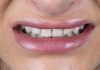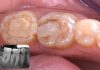


In a world where appearance takes center stage, patients increasingly seek youthful, radiant, and flawless smiles. This growing demand presents dentists with a critical challenge: delivering stunning aesthetics while safeguarding the natural integrity of teeth. The era of sacrificing dental tissues with drills for cosmetic purposes is a thing of the past. Advancements in materials and techniques now enable remarkable smile transformations that respect dental structures. Achieving this balance between aesthetics and preservation requires meticulous treatment planning and collaboration between the dentist and a skilled dental technician, ensuring results that are both lasting and naturally beautiful.


Fig.1
A young patient visits the clinic after completing orthodontic treatment, seeking a solution to close the gaps between the upper incisors. With a Class I canine and molar relationship, the treatment plan must focus on addressing the esthetic and functional needs of the four upper incisors.

Fig.2
A retracted view of the four incisors reveals the spaces to be managed. The dental technician (AD Digital Prothèses, Marseille, France) is tasked with creating a wax-up that ensures harmony and proper proportions between the teeth.


Fig.3
In this type of treatment, testing the project directly in the mouth and obtaining patient approval is essential. The mock-up is transferred onto the teeth using a silicone key filled with bis-acryl resin. Satisfied with the result and opting out of bleaching, the patient approved the project. The next step involves creating four ceramic veneers.

Fig.4
The first step before any procedure is to check the color. This must be done at the start of the appointment when the teeth are not dehydrated.

Fig.5
A cross-polarized photograph assists the dental technician in accurately reproducing the tooth color.

Fig.6
The preparation will be minimally invasive, performed using a validated mock-up to ensure maximum preservation of enamel.

Fig.7
Gauges are created in the mock-up and marked with a pencil for clear reference.

Fig.8
Once the mock-up is removed, the pencil marks guide the areas to be removed, while the unmarked regions will be left intact.

Fig.9
The preparations must be carefully polished to ensure a smooth and refined finish.

Fig.10
To ensure sufficient space for the ceramics, a silicone key is created from the wax-up, cut in the middle of each tooth, and used to verify the correct amount of space. Once this step is confirmed, a silicone impression is taken.

Fig.11
The provisional restorations are created using the mock-up once again. The laboratory must now carefully duplicate this design for the ceramic veneers.

Fig.12
Try in one of the four ceramic veneers. If possible, this step can be performed without anesthesia, allowing both the patient and dentist to evaluate the outcome. The material used is EZneer (Aidite, Qinhuangdao, China), a zirconia treated with Biomic LiSi Connect (Aidite, Qinhuangdao, China) for optimal bonding. The LiSi layer, applied to the zirconia surface, enables the veneers to bond similarly to glass ceramic restorations.

Fig.13
The try-in procedure with a retracted view.

Fig.14
The bonding procedure is carried out under rubber dam isolation, starting with 50 µm sandblasting, followed by 30 seconds of etching. Afterward, the bonding agent is cured, and the bonding paste is applied.

Fig.15
Final result after rubber dam removal.

Fig.16
The direct post-operative smile shows the immediate aesthetic results after the bonding procedure, highlighting the fit and appearance of the ceramic veneers.

Fig.17
A few weeks later, the ceramic restoration shows excellent integration. The gums are healthy, the papillae have returned, and the patient is satisfied with the results.
Conclusions
Through this clinical case, it can be concluded that by attentively considering the patient’s needs and meticulously planning each step of the treatment, it is possible to achieve an aesthetic outcome with a minimally invasive approach.
Bibliography
- Juneja Ajay – https://www.styleitaliano.org/the-power-of-4-preserving-dental-tissue/
- Gürel G. De la théorie à la pratique: les facettes en céramique. Quintessence International, 2005.
- Koubi S. Facettes en céramique. Quintessence Publishing 2019.
- Magne P, Belser U. Dentisterie restauratrice biomimétique. Quiintessence Publishing 2022.
- Richelme J, Etienne O, Camaleonte G, Weisrock G, Ortet S, Faucher AJ, Paris JC. Trucs et astuces de l’académie du sourire. Réussir 2.0. Quintessence Publishing 2024.
- Lasserre JF. Fusion, art et nature dans les restaurations céramiques. Quintessence Publishing 2020.